Dallas Real Estate and Community News

July 7, 2026

Lake Carolyn Condos and Townhomes: Urban Village Living in Las Colinas, Irving

Lake Carolyn is one of the most distinctive residential pockets in North Texas, especially for buyers who want a mix of water views, walkability, and true urban convenience. In the heart of Las Colinas, this area feels more like a walkable urban village in Irving than a traditional suburban condo market, with lakefront paths, nearby dining and entertainment, and DART Orange Line access all woven into the daily lifestyle.

For buyers who want low-maintenance living without giving up access to amenities, Lake Carolyn is worth a close look. The area sits inside the larger Las Colinas Urban Center, which has been developed as a transit-oriented, mixed-use district with residential buildings, offices, hotels, restaurants, event space, and public walkways clustered around the lake.

Why Lake Carolyn stands out

The biggest appeal of Lake Carolyn is the way it combines scenery and convenience. You get a lakefront setting, a growing promenade system, and direct access to the Las Colinas Urban Center Station, which is served by the DART Rail Orange Line. That gives residents an easy connection to broader parts of the metroplex while keeping daily life centered around one of Irving’s most polished neighborhoods.

The Lake Carolyn Promenade is a major part of that appeal. DART notes that the station provides a direct connection to the promenade, which loops the lake and serves local businesses, hotels, and Levy Event Plaza, while the City of Irving has continued to invest in expanding the walkway and improving pedestrian access around the lake.

Transit and walkability

If you are a buyer who values walkability, this area makes a strong case. Las Colinas Urban Center Station is located on Lake Carolyn Parkway just south of O’Connor Boulevard, and DART identifies it as a station on the Orange Line near the shores of Lake Carolyn.

That transit access matters because it helps define the entire neighborhood experience. Instead of being car-dependent in the usual suburban sense, residents can walk to rail, stroll the promenade, and reach restaurants, hotels, entertainment, and nearby destinations tied to the Las Colinas core. The area really does function like a compact urban district inside Irving.

Grand Treviso spotlight

Grand Treviso is one of the signature condo buildings in this market and a strong example of what Lake Carolyn living can look like. It is a high-rise condominium at 330 E Las Colinas Blvd in the heart of the Las Colinas Urban Center, and it sits across from Lake Carolyn with direct appeal for buyers who want a more urban, lock-and-leave lifestyle.

For many buyers, Grand Treviso stands out because it offers condo living with a premier location near the lake, walkable access to the surrounding district, and proximity to DART. A nearby condo listing also describes the building as offering luxury amenities such as concierge service, rooftop pool, fitness facilities, and gated parking, which helps explain why it continues to attract buyers who want convenience and a more elevated residential feel.

InTown at Las Colinas Station spotlight

InTown at Las Colinas Station gives buyers a different but equally appealing option: newer townhome-style living in a highly connected part of Las Colinas. It is positioned near the DART Orange Line and Lake Carolyn, making it attractive for buyers who want the feel of a modern neighborhood while still staying close to the same walkable district.

This community is a good fit for buyers who want more space than a typical condo, but still want a low-maintenance home in a vibrant location. Listings connected to the community describe quick access to dining, entertainment, and transit, which reinforces its appeal for people who want convenience without sacrificing the privacy and function of a townhome.

Condo or townhome

For buyers deciding between Grand Treviso and InTown at Las Colinas Station, the choice often comes down to lifestyle. Grand Treviso is the better fit for someone who wants high-rise condo living, lake views, and a more vertical urban experience. InTown at Las Colinas Station is better for someone who wants a townhome layout, newer construction feel, and a bit more separation from the condo lifestyle while staying in the same walkable district.

Both options benefit from the same larger neighborhood strengths: the lake, the promenade, the DART Orange Line, and the broader Las Colinas Urban Center environment. That shared setting is what gives Lake Carolyn its identity and why buyers often see it as one of the most lifestyle-driven residential areas in Irving.

Why buyers like this area

Lake Carolyn appeals to buyers who want more than just a home; they want a setting that supports daily routines, weekend outings, and easy commuting. The area’s blend of water views, trails, transit, and entertainment creates a neighborhood feel that is harder to find in many other parts of the metroplex.

It also appeals to buyers who want a property that feels connected to something larger than the building itself. Whether the goal is a lock-and-leave condo, a townhome with a more spacious layout, or simply a home in a location that feels energetic and polished, Lake Carolyn offers a compelling mix of livability and location.

Final thought

If you are exploring condo and townhome options around Lake Carolyn, the story is bigger than individual buildings. This is one of those rare Irving submarkets where the combination of transit, walkability, lakefront setting, and urban design creates a genuine sense of place. For buyers who want a walkable urban village in Irving, Lake Carolyn and Las Colinas deserve a serious look.

July 1, 2026

How to Buy and Sell at the Same Time in Texas: Your Dallas Move-Up Guide for 2026

How do you buy and sell a home at the same time in Texas?

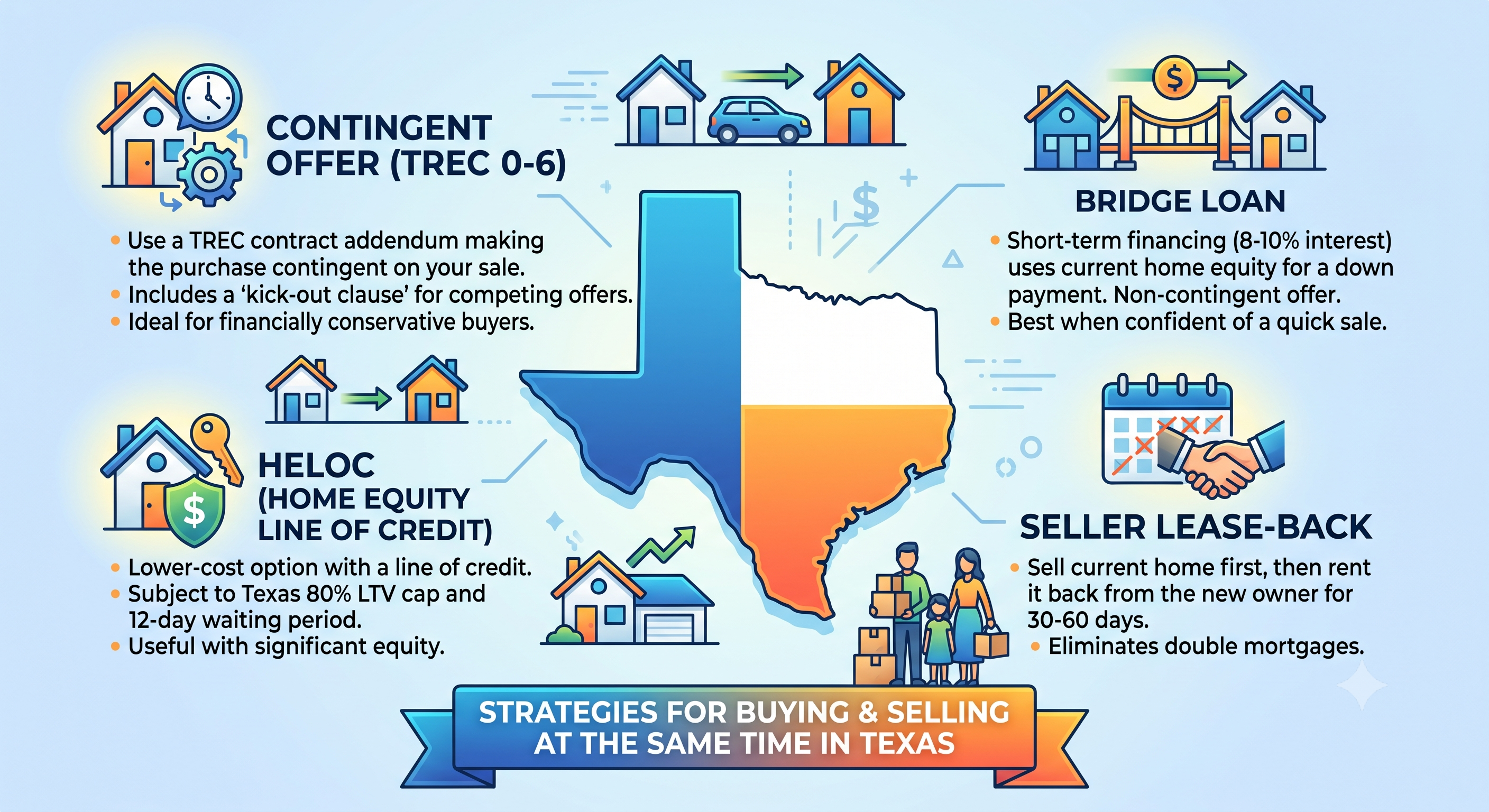
In Texas, buyers who need to sell their current home before closing on a new one have four main options: a contingent offer using the TREC Addendum for Sale of Other Property (Form 10-6), a bridge loan (short-term financing at 8–10% interest), a home equity line of credit (HELOC, subject to Texas constitutional limits), or a seller lease-back arrangement after their current home closes. The right strategy depends on your equity position, how quickly your departure home is likely to sell, and how much financial risk you can absorb during the overlap. In Dallas's 2026 buyer's market, where homes in Uptown and Oak Lawn are averaging around 59 days on market, timing coordination matters more than it has in years.

By Matt Watson, Broker, REALTOR® | July 1, 2026


Moving up in Dallas is one of the most common situations I work through with clients right now. You've found the next place. You love it. And you can't afford to own both homes at once. Or maybe you technically could, but not for long.

What makes this tricky in Texas is that you're navigating two separate contracts, two separate timelines, and a legal framework that adds some rules most national advice leaves out. Let's go through your four main options and what each one actually costs you in time, money, and risk.

Your Four Options

Option 1: Contingent Offer (TREC Form 10-6)

The most financially conservative path is making your purchase contingent on selling your current home first. Texas has a specific contract addendum for this: the Addendum for Sale of Other Property by Buyer (TREC Form 10-6). Your agent fills in your current property address, a contingency deadline, and the kick-out clause terms.

The kick-out clause is the part most buyers don't fully understand. Once a seller accepts your contingent offer, they can keep marketing the home. If another buyer comes in with a clean offer, the seller sends you written notice — typically giving you 72 hours to either waive the contingency and commit to buying without your sale, or release the contract and get your earnest money back. It's not a guarantee you lose the house. It's a forced decision point.

One rule that trips people up: most sellers in Dallas won't accept a contingent offer unless your current home is already active on the MLS. If you're planning to go this route, get your home listed before you start submitting offers on the next one.

In Dallas's 2026 buyer's market, contingent offers are more viable than they've been in several years. Sellers in Uptown and Oak Lawn are sitting on inventory longer and are generally more open to negotiating terms. But if you're targeting a well-priced property where two or three buyers are looking at the same time, a contingent offer will usually lose to a clean one.

Option 2: Bridge Loan

A bridge loan is short-term financing that uses the equity in your current home as collateral. You borrow against what you own to fund the down payment on the new home, then repay the bridge loan when your current home sells. The advantage: your offer on the new home is clean, not contingent.

The math works, but it isn't cheap. Bridge loans in Texas are running 8% to 10% interest in mid-2026, with origination fees of 1.5% to 3% of the loan amount. Terms are typically 6 to 12 months. Most lenders require at least 20% equity in your current home, and most want it listed before they'll fund.

Here's a real example. Say your current home is worth $500,000 and you owe $250,000. You want to borrow $150,000 as a bridge to fund the down payment on the next place. At 9% interest for six months, that's roughly $6,750 in interest, plus $2,250 to $4,500 in origination fees. You're paying $9,000 to $11,000 to make a non-contingent offer.

Whether that's worth it depends on how much competition you expect on the purchase side, and how confident you are your current home sells within six months. Given that Oak Lawn and Uptown are running 59-day average market times right now, budget accordingly.

Option 3: HELOC (Home Equity Line of Credit)

If you have significant equity and some runway before you need to move, a HELOC is a lower-cost alternative to a bridge loan. You open a line of credit against your current home's equity, draw from it for the down payment on your next purchase, then repay it after you close on your sale.

Texas has some of the strictest home equity rules in the country, and they apply here. Under Article XVI, Section 50 of the Texas Constitution:

  • All home equity debt on your primary residence — your original mortgage plus the HELOC — cannot exceed 80% of your home's appraised value
  • There's a mandatory 12-day waiting period between application and funding
  • You can only have one home equity loan or HELOC at a time on your Texas homestead

The 80% combined loan-to-value cap is the one that limits people most. If you owe $350,000 on a $500,000 home, your maximum total home equity borrowing is $50,000 ($500K × 80% = $400K, minus $350K already owed). If $50,000 isn't enough for a meaningful down payment on the next home, the HELOC may not solve the problem.

The upside: HELOC interest rates are significantly lower than bridge loan rates, and if you draw and repay quickly, the total cost is much lower than a bridge.

One more timing note: the 12-day waiting period is mandatory. You can't waive it. If you need funding quickly for a purchase, account for that gap in your planning.

Option 4: Seller Lease-Back

A lease-back flips the sequence. You sell your current home first, then negotiate a short-term lease with your buyer that lets you stay in the property for 30 to 60 days while you finalize your next purchase.

This approach eliminates the double-mortgage problem entirely. You close, you receive your proceeds, and you use them for the down payment on the next home while continuing to live where you are through the transition period.

The risk lands on the purchase side. If you're buying in a sub-market where the home you want might not wait 30 to 60 days, you could sell your current home without a clear landing spot. You'll want the lease-back terms documented in writing — rent amount, security deposit, what happens if your next closing is delayed.

In Dallas's current market, buyers are generally open to lease-backs. Many sellers in Uptown and Oak Lawn are offering them as a negotiating concession. If you're in that position, it can actually make your listing more appealing because it signals you're a motivated seller who has a plan.

The Simultaneous Close: When Both Transactions Happen the Same Day

The cleanest version of all of this is coordinating both closings on the same day. You close on your current home in the morning, the funds wire over, and you close on the new home in the afternoon. You walk out of the title company with keys.

This requires your agents, your lender, and both title companies to communicate tightly from the beginning. Your purchase lender needs to be prepared to fund once your sale proceeds clear. It's doable and it happens regularly in Dallas, but it requires planning from the moment you go under contract on your departure home. If either closing runs into a delay, the other one can cascade.

This is exactly the situation where having one agent coordinating both sides saves you a lot of stress. I've handled a number of these for clients in Uptown, Oak Lawn, East Dallas, and North Oak Cliff. The mechanics aren't magic, they're just coordination.

What Goes Wrong (And How to Avoid It)

The most common mistake: overpricing the departure home. In 2026, I still see sellers anchoring their price to 2022 peak comps. That's not what the market is paying today. Uptown and Oak Lawn condos and townhomes are averaging 59 days on market, and price reductions are common. If your strategy assumes your current home sells in three weeks, build in a significant buffer.

The second most common mistake: skipping a pre-listing inspection on your current home. If the buyer's inspector surfaces a foundation problem or a roof issue, your closing gets delayed. When two transactions are running in parallel, a delay on one side can trigger rate lock expirations, missed contract deadlines, and lost earnest money on the other side. A pre-listing inspection typically costs $300 to $500 and saves you from that scenario.

The third mistake is rounding errors on proceeds. Before you pick a strategy, you need to know what you'll actually net from your current sale after commissions, title fees, tax prorations, and any concessions to the buyer. That net number is what you're working with for your next down payment. If you're estimating, you might be planning around money you won't actually have. For the full breakdown on what sellers in Dallas typically walk away with, this post on what you'll net selling your Dallas home in 2026 walks through the real numbers.

Getting the Numbers Right Before You Decide

Before you commit to any strategy, you need an honest current market analysis on your departure home. Not a Zestimate. Not a price your neighbor got two years ago. A real look at what homes like yours in your specific Dallas neighborhood are selling for right now and how long they're taking to go under contract.

That number drives everything: which financing strategy makes sense, what contingency deadline to request in your purchase offer, and how much timing risk you're actually taking on. For buyers using seller concessions on the purchase side to help with closing costs, this post on seller concessions in Dallas for 2026 covers how to structure that ask once you have a home under contract.

Every situation is different. The right move for someone with $300,000 in equity and a fast-moving departure home looks completely different than the right move for someone with $80,000 in equity and a condo that needs work. The only way to know which strategy fits is to run the actual numbers.


Frequently Asked Questions

Does a contingent offer mean I'll lose the house if another buyer shows up?

Not necessarily. The kick-out clause gives you a window — typically 72 hours in Texas — to waive the contingency and commit to buying without the sale of your current home. If you have a bridge loan or HELOC pre-arranged, you can drop the contingency quickly when the notice arrives. If not, you release the contract and receive your earnest money back in full.

How much equity do I need to use a HELOC or bridge loan in Texas?

For a HELOC, Texas law caps all home equity debt at 80% of your home's appraised value. You need enough equity above your current mortgage balance to borrow a useful amount. For a bridge loan, most lenders require at least 20% equity. Most move-up buyers in Dallas's urban core who have owned for three or more years have enough equity to qualify for one or both options.

Can I use the proceeds from my home sale to close on the new one the same day?

Yes, and it happens regularly in Dallas. Both title companies coordinate the wire transfers, and your purchase lender needs to be prepared to fund once your sale proceeds clear. It requires communication between all parties from the beginning, but a same-day closing is the cleanest outcome when it comes together.

What is the TREC Addendum for Sale of Other Property?

It's TREC Form 10-6, the official Texas contract addendum that makes your purchase offer contingent on selling your current home first. It specifies your current property address, the deadline by which your home must sell, and the kick-out clause terms — typically giving the seller the right to send a 72-hour notice if another offer arrives. Your agent fills it out and attaches it to your purchase offer.

How long does it take to close on both homes in Dallas?

A typical Dallas contract-to-close runs 30 to 45 days for a financed purchase. For simultaneous closings, both timelines need to align. The most common challenge is the departure home taking longer to sell than expected. In Uptown and Oak Lawn's current market, budget 45 to 75 days for your current home to go from listing to closed.


Buying and selling at the same time in Texas is manageable — the complexity is real, but it's the kind that planning and good coordination can handle. The biggest risk isn't the paperwork. It's going in without an accurate picture of your departure home's value and timeline in today's market.

If you're working through this move, I'd be glad to put together a free market analysis on your current home and walk through which of these strategies makes sense for your situation. No pressure, no obligation — just real numbers from someone who knows these neighborhoods. Reach out at mattwatson.com.


About Matt Watson, Broker, REALTOR®
Matt Watson is a Dallas-based real estate broker and REALTOR® with over 25 years of experience in the city's urban core neighborhoods. He specializes in condos, townhomes, and single-family homes in Uptown, Oak Lawn, East Dallas, and North Oak Cliff. Whether you're buying your first condo or selling a longtime home, Matt brings deep local knowledge and straightforward guidance to every transaction. Connect with Matt at mattwatson.com.

June 17, 2026

Seller Concessions in Dallas, TX: What Buyers Can Get in 2026 and How to Ask

Can Dallas home buyers negotiate seller concessions in 2026?

In today's Dallas buyer's market, nearly half of all transactions include seller concessions. Concessions are funds the seller pays toward your costs at closing — they can cover lender fees, title charges, prepaid property taxes, homeowner's insurance, and discount points, including a seller-funded rate buydown. On homes priced between $400,000 and $700,000 in Dallas, $8,000 to $15,000 in concessions is now standard. The maximum your lender will allow depends on your loan type: conventional loans with less than 10% down cap concessions at 3% of the purchase price, FHA loans cap at 6% of the sale price, and VA loans allow 4% for concession-category items.

By Matt Watson, Broker, REALTOR® | June 17, 2026

Nearly half of Dallas home sales right now include seller concessions. If you're buying in Uptown, Oak Lawn, East Dallas, or North Oak Cliff and you're not asking for them, you're leaving money at the closing table.

The market has shifted. Inventory in Dallas is at a decade high. More than 73% of homes are selling below asking price. Sellers who were fielding multiple offers two years ago are watching their listings sit for 60 to 90 days. That's leverage for you as a buyer — but only if you know how to use it.

This is one of the most common questions I get from buyers right now: How do I ask for seller concessions without killing the deal? Here's how it works.

What Seller Concessions Are — and What They Cover in Texas

A seller concession is money the seller agrees to pay toward your costs at closing. Instead of reducing the sale price, the seller credits you funds that cover expenses you'd otherwise pay out of pocket on closing day.

In Texas, seller concessions can cover:

  • Lender fees (origination, underwriting, processing charges)
  • Title insurance and related title charges
  • Escrow prepaids (first-year homeowner's insurance, prepaid property taxes, prepaid mortgage interest)
  • HOA dues and transfer fees at closing
  • Discount points (permanently buying down your interest rate)
  • A temporary rate buydown, like a 2-1 or 1-0 structure

What concessions cannot cover: your down payment, your earnest money deposit, or any item your lender specifically disallows. If you're not sure what your lender permits, ask before you make the offer — your agent can coordinate that conversation quickly.

If you want to see the full closing cost picture before you negotiate, this breakdown of what buyers actually pay at closing in Dallas is a good place to start.

How Much You Can Ask For: The Limits by Loan Type

Your lender — not the seller, not your agent — determines the cap on seller concessions. Exceed that cap and your lender will reject the credit at underwriting. Here's what each loan type allows:

  • Conventional with less than 10% down: 3% of the purchase price
  • Conventional with 10–24.99% down: 6% of the purchase price
  • Conventional with 25% or more down: 9% of the purchase price
  • FHA loan: 6% of the sale price
  • VA loan: 4% for concession-category items (standard closing costs are separate and not subject to this cap)

To put numbers on it: on a $450,000 Dallas home with a conventional loan and 5% down, you can ask for up to $13,500 in seller-paid concessions. On an FHA loan at the same price, the cap is $27,000 — though asking for that full amount would be unusual and might trigger appraisal scrutiny.

In practice, Dallas buyers asking for $8,000 to $15,000 on homes in the $400,000 to $700,000 range are getting it in the current market. The 2% rule is a common starting point among Texas agents — 2% of the purchase price tends to cover most standard buyer closing costs without raising flags with the seller or the lender.

The 2-1 Buydown: The Most Useful Concession in 2026

A price cut reduces what the seller nets. A closing cost credit reduces what you pay at the table. But a rate buydown reduces what you pay every month for the first two years — which for many buyers right now is the most valuable thing a seller can offer.

Here's how a 2-1 buydown works. The seller deposits a lump sum into an escrow account at closing. Your lender draws from that account each month to reduce your interest rate by 2 percentage points in year one and 1 percentage point in year two. In year three and beyond, your rate returns to the full note rate you locked.

The math on a $405,000 loan at a 6.5% note rate:

  • Year 1 at 4.5%: $1,879/month
  • Year 2 at 5.5%: $2,098/month
  • Year 3 and beyond at 6.5%: $2,329/month

Total payment savings over the first two years: roughly $8,600. Cost to the seller: approximately $9,000 to $10,000.

One detail worth knowing: if rates drop and you refinance before your buydown period ends, any unused funds left in the escrow account come back to you at closing. So you're not locked in — the buydown is a floor, not a ceiling.

For buyers looking at condos and townhomes in Uptown or Oak Lawn, where HOA fees already add to your monthly carrying cost, a 2-1 buydown can make the first two years genuinely manageable while you wait to see where rates settle.

How to Structure the Ask

There are two proven approaches. Which one fits depends on the property, the asking price, and how long it's been sitting.

Approach 1: Full price with a concession request

Offer the asking price and request a specific dollar amount in seller-paid closing costs or a rate buydown. The seller still nets close to their target. This is the cleanest structure and the most commonly accepted one in today's Dallas market.

Example: "We offer $475,000, as listed, with $9,500 in seller-paid closing costs applied toward a 2-1 buydown."

Approach 2: Above asking with concessions built in

Offer slightly above the asking price and request concessions equal to the difference. The seller's net is roughly the same, but the concession is now incorporated into the financed amount. This is sometimes useful when you need to roll closing costs into the loan balance and your loan type allows it.

Example: "We offer $484,500 with $9,500 in seller-paid closing costs." The seller nets $475,000 after the concession, same as their asking price.

One important rule regardless of which approach you use: let your agent make the ask, not you. Buyers who try to negotiate directly with the listing agent or the seller lose leverage and sometimes damage the relationship with the other side. Your agent knows how to frame the request in a way that's professional and non-offensive. That framing matters more than you might think.

What Gives You the Most Leverage

Not every seller will agree to concessions. Here's what increases your odds:

  • The property has been on the market 30 days or more. Dallas homes sitting longer than 30 days average higher concession amounts. Properties on market 90-plus days are averaging $7,300 in concessions across North Texas. A home that's been sitting is a motivated seller.
  • You're bringing a full-price or near-asking offer. Asking for $10,000 in concessions while also coming in $20,000 below asking is a difficult combination. Asking for $10,000 in concessions at full price is accepted regularly. The seller still hits their number.
  • You have a strong pre-approval letter. A solid pre-approval from a reputable lender tells the seller you're committed and qualified. That confidence makes them more willing to help fund your costs.
  • You're flexible on the closing timeline. A seller who needs extra time to move, or who is simultaneously buying another home, may trade closing cost credits for schedule flexibility. Your agent will know whether to explore this.

What Kills the Ask

A few mistakes can turn a reasonable concession request into a deal-killer:

  • Stacking too many demands. Concessions plus a long list of inspection repairs plus a short option period plus a buyer's home warranty request puts a lot of pressure on the seller at once. Prioritize what matters most.
  • Asking for more than your lender allows. If you request concessions above your loan type's cap, your lender will reduce the credit at underwriting. Ask your lender to confirm your maximum before you submit the offer.
  • Waiting until after inspection to bring up concessions. The best time to negotiate concessions is in your initial offer. Inspection negotiations are a separate conversation about condition and repairs. Mixing the two creates confusion and friction.
  • Going in too low on price while also asking for concessions. Sellers can see through the math. If you're asking them to discount the price AND cover your closing costs, you're asking them to give twice. That's usually a harder conversation than one clean ask at full price.

If you're buying a condo in Uptown or Oak Lawn, keep in mind that your total monthly cost includes HOA dues in addition to your mortgage payment. Understanding how HOA fees work for Uptown condos before you make your offer helps you set the right concession amount for your situation.

Frequently Asked Questions

What are seller concessions in Texas?

Seller concessions in Texas are funds the seller agrees to pay toward the buyer's costs at closing. In Texas, concessions can cover lender fees, title insurance charges, escrow prepaids (property taxes, homeowner's insurance, prepaid mortgage interest), discount points, and temporary rate buydowns. They cannot cover the buyer's down payment or earnest money.

How much can I ask for in seller concessions on a Dallas home?

The maximum depends on your loan type. Conventional loans with less than 10% down allow up to 3% of the purchase price. FHA loans allow up to 6% of the sale price. VA loans allow 4% for concession-category items. On homes between $400,000 and $700,000 in Dallas, $8,000 to $15,000 in negotiated concessions is standard in the current market.

What is a 2-1 buydown and how does it work?

A 2-1 buydown is a seller-funded temporary rate reduction. The seller deposits a lump sum into an escrow account at closing, and your lender draws from it monthly to reduce your interest rate by 2% in year one and 1% in year two. Your rate returns to the full note rate in year three. On a $405,000 loan at 6.5%, a 2-1 buydown saves the buyer roughly $8,600 over the first two years and costs the seller approximately $9,000 to $10,000.

Does asking for seller concessions hurt my offer in Dallas?

Not if you ask correctly. A concession request paired with a full-price offer is accepted regularly in today's Dallas market. What hurts an offer is combining a below-asking price with a large concession request — sellers see through that math quickly. The cleanest approach is offering at or near asking price and requesting a specific dollar amount in seller-paid costs. Let your agent make the ask.

Can seller concessions be used for a rate buydown in Texas?

Yes. In Texas, seller concessions can fund discount points (permanently reducing your rate) or a temporary buydown like a 2-1 structure. The seller pays the buydown funds into an escrow account at closing, and your lender applies the credits monthly. This is the most common concession structure in the DFW market right now and counts toward your loan type's seller contribution limit.


The Dallas market is giving buyers real leverage right now. Sellers who were receiving multiple offers two years ago are open to conversations they wouldn't have had then. The key is knowing what to ask for, how much to ask for, and how to frame the ask in a way that keeps the deal moving.

If you're planning to buy in Dallas's urban core and want to understand what concessions make sense for your specific situation — price range, loan type, property type — I'm happy to walk you through it. There's no pressure and no obligation. Schedule a free buyer consultation at mattwatson.com and let's look at the numbers together.


About Matt Watson, Broker, REALTOR®
Matt Watson is a Dallas-based real estate broker and REALTOR® with over 25 years of experience in the city's urban core neighborhoods. He specializes in condos, townhomes, and single-family homes in Uptown, Oak Lawn, East Dallas, and North Oak Cliff. Whether you're buying your first condo or selling a longtime home, Matt brings deep local knowledge and straightforward guidance to every transaction. Connect with Matt at mattwatson.com.

June 12, 2026

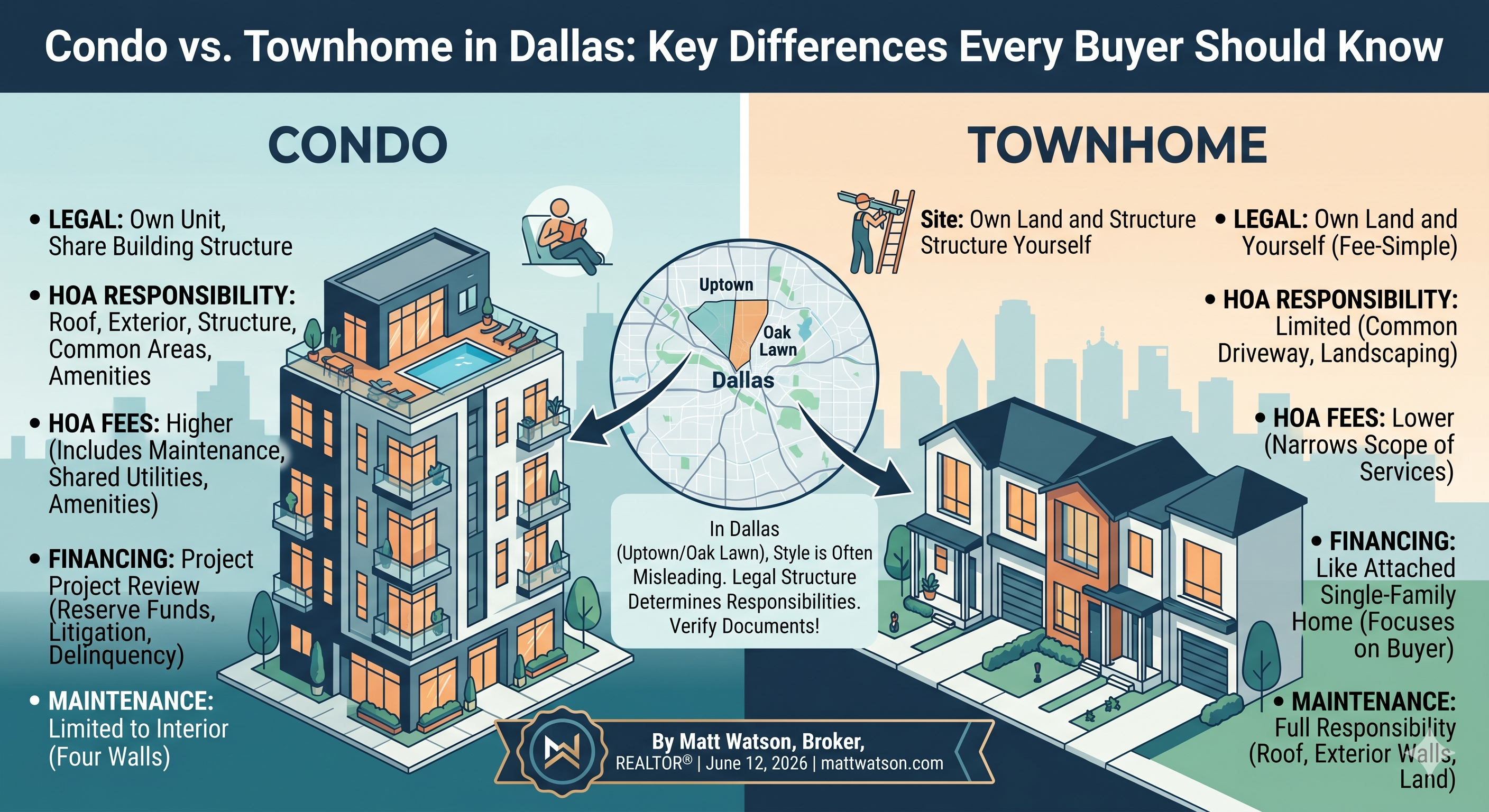
Condo vs. Townhome in Dallas: Key Differences Every Buyer Should Know

What's the difference between a condo and a townhome in Dallas?

In Dallas, a condo is a legal form of ownership where you own your unit and share an interest in the building's common areas, with the HOA responsible for the structure and exterior. A townhome describes a style of attached, multi-floor home — but it may be legally organized as either a condo or a fee-simple property where you own the land and structure yourself. The difference determines your HOA fees, how your financing works, who handles exterior maintenance, and what your insurance needs to cover. In Uptown and Oak Lawn, many properties listed as "townhomes" are actually condos — always verify the governing documents before making an offer.

By Matt Watson, Broker, REALTOR® | June 12, 2026


When you're browsing Zillow or Redfin for homes in Uptown or Oak Lawn, you'll see the same types of properties labeled different things. A multi-story attached home with a private entrance and a garage might be listed as a "condo." The unit next door, nearly identical, might be listed as a "townhome." Sometimes they're in the same building.

This isn't a listing error. It's a reflection of real confusion that exists in Dallas's urban core market — and it matters more than you might think.

The legal structure of what you're buying affects your monthly costs, your financing options, your insurance coverage, and who pays for the roof when it starts leaking. Getting this wrong isn't just a paperwork issue. It's a financial one.

How a Condo and a Townhome Are Actually Different

The word "townhome" describes a style of home. It's typically multi-floor, attached to neighboring units, with a private entrance, often a garage on the ground floor, and living space above. That description applies to hundreds of properties in Uptown, Oak Lawn, and East Dallas.

The word "condo" describes a legal form of ownership. In a condominium, you own your unit and hold an undivided interest in the shared building components — the roof, the structure, the hallways, the common areas. The HOA holds and manages those shared components on behalf of all the owners.

Here's where Dallas buyers get tripped up: a townhome-style property may be organized as a condominium. It looks like a townhome. It has stairs, a garage, and neighbors sharing walls. But legally it's a condo — and that changes how the association is structured, how the property is financed, and what you're responsible for maintaining.

The other possibility is a fee-simple townhome, where you own the land beneath your unit and the entire structure, not just the airspace inside. The HOA in this case handles limited common areas: a shared driveway, landscaping, maybe a gate. The exterior walls and the roof? That's yours.

You can't tell which one you're looking at from the listing photos. You have to look at the legal documents.

When you're under contract, the seller will provide the governing documents: the Declaration, the bylaws, and the condo plat (if applicable). If the Declaration establishes a "condominium regime," you're buying a condo regardless of what the listing called it. Your agent should be pulling and reviewing these documents during the option period — before your earnest money is truly at risk.

What Changes Based on the Ownership Structure

Once you know what you're actually buying, the financial picture comes into focus.

HOA fees

In Uptown and Oak Lawn, condo HOA fees run from roughly $200 to $1,200 or more per month, depending on the building. A full-service luxury high-rise with a doorman, concierge, valet parking, pool, and gym lands on the higher end. A smaller boutique mid-rise with fewer amenities might run $250 to $400. Fees cover exterior maintenance, building insurance for the structure, elevators, and shared utilities.

Fee-simple townhome HOAs typically run $100 to $400 per month and cover a much narrower scope: landscaping, a shared driveway, maybe common-area pest control. You're not paying for someone to maintain a lobby or repair an elevator because those don't exist.

If a property is listed as a "townhome" but is actually organized as a condo regime, its HOA fees will look more like a condo than a fee-simple property. The governing documents will tell you what the association covers.

Financing

This is the difference that catches the most buyers off guard, especially when comparing similar-looking properties side by side.

With a fee-simple townhome, lenders treat the property like an attached single-family home. The underwriting process focuses on your credit, income, and assets. It's relatively straightforward.

With a condo — whether it's labeled a condo or listed as a townhome but legally organized as one — the lender reviews the entire project, not just your unit. They're evaluating the HOA's financial health, the reserve fund balance, the owner delinquency rate, whether there's active litigation against the association, and the owner-occupancy ratio in the building. If the building doesn't meet Fannie Mae, Freddie Mac, FHA, or VA criteria, your conventional financing options may be limited or unavailable entirely.

I've covered what makes a condo warrantable vs. non-warrantable in detail if you want to dig into the eligibility criteria. But the short version is this: before you fall in love with a unit, verify the building is approved for the loan type you're planning to use. Your lender should run a condo eligibility check early in the process, not after you've waived your option.

Maintenance and insurance

In a condo, the HOA's master insurance policy covers the building's structure and exterior. Your individual policy (an HO-6 policy, often called condo insurance) covers your interior finishes, personal belongings, and liability inside your unit. Your personal maintenance responsibility is limited to what's within your four walls.

In a fee-simple townhome, your insurance needs to cover more — the roof, the exterior, the structure. What you're personally responsible for depends on what the HOA master policy covers, so reading those documents carefully is essential before you close.

In a condo-regime townhome, the HOA master policy covers the structure, similar to a traditional condo. But again, you won't know this from the listing — you'll know it from the governing documents.

Which One Is Right for You in Dallas?

This doesn't have a universal answer. It depends on what you're optimizing for.

If you want low personal maintenance responsibility and you're drawn to the walkability and amenities of a full-service building in Uptown, a condominium is likely a natural fit. You'll pay more in monthly HOA fees, but those fees cover more. When the roof needs work, that's the association's problem, not yours.

If you want more control over your property, a private garage you own outright, and lower HOA fees in exchange for handling your own exterior, a fee-simple townhome is worth looking at. East Dallas and North Oak Cliff have more fee-simple attached options than the denser parts of Uptown.

If you're financing with an FHA loan or a VA loan, the condo eligibility question becomes critical early in your search. Some buildings in Dallas's urban core are approved; others aren't. Starting your search knowing your financing type helps you filter for eligible buildings from the beginning.

And if you're working with a specific monthly budget — mortgage plus HOA plus taxes plus insurance — running the total cost comparison matters as much as the purchase price. A condo priced at $375,000 with a $650/month HOA has a very different monthly payment than a fee-simple townhome at the same price with a $200/month HOA. The total cost is what you'll actually live with every month.

For a closer look at what to scrutinize in the HOA documents before you close, see how to navigate HOA fees when buying a condo in Uptown Dallas.

The right move, regardless of property type, is to have a local agent pull the governing documents and the resale certificate early — before you get emotionally invested in a unit that has a problem you didn't know about.


Frequently Asked Questions

Can a townhome in Dallas be legally organized as a condominium?

Yes, and this is one of the most common points of confusion in Dallas's urban core market. The word "townhome" describes a style of home — multi-floor, attached, private entry — not a legal ownership structure. A property listed as a townhome on Zillow or the MLS may be governed by a condominium regime, meaning the HOA owns the common elements and exterior, and your financing will go through condo underwriting. Always request the Declaration and bylaws to confirm the legal structure before making an offer.

What are typical HOA fees for condos vs. townhomes in Uptown Dallas?

Condo HOA fees in Uptown typically range from $200 to $1,200 or more per month depending on the building and its amenities. Fee-simple townhome HOAs are usually $100 to $400 per month covering more limited common areas. The difference reflects what the association is responsible for: a full-service condo building has far more shared infrastructure to maintain than a townhome development with a shared driveway and landscaping.

Is it harder to finance a condo than a townhome in Dallas?

It depends on the property's legal structure. Fee-simple townhomes go through standard single-family underwriting and are generally straightforward to finance. Condos — including properties styled as townhomes but legally organized as condos — require the lender to review the entire project for warrantability. Buildings with low owner-occupancy ratios, underfunded reserves, or active HOA litigation may not qualify for conventional, FHA, or VA financing, which limits your loan options and can affect your interest rate.

Who is responsible for the roof on a condo vs. a fee-simple townhome?

In a condominium, the HOA is responsible for the building's roof, exterior, and structural components. Your individual condo policy covers only the interior. In a fee-simple townhome, you typically own the structure and are responsible for your own roof, though the specific division of responsibility depends on the HOA governing documents — some townhome associations cover exterior components and others do not.

Are there true fee-simple townhomes in Uptown or Oak Lawn?

Yes, though they're less common than condo-regime properties in the densest parts of Uptown. You're more likely to find fee-simple attached homes in parts of Oak Lawn, East Dallas, and North Oak Cliff. In Uptown's core, many townhome-style properties are organized as condominiums. The only way to confirm which you're looking at is to review the Declaration. Your agent should be able to identify this in the documents early in the option period.


The condo vs. townhome question in Dallas isn't really about style — it's about legal structure, and the legal structure drives your monthly costs, your financing options, and your maintenance obligations. In Uptown and Oak Lawn especially, the property that looks like a townhome may be legally a condo, with all the HOA fees and project-level financing requirements that come with it.

If you're shopping for a condo or townhome in Dallas's urban core and want a clear-eyed look at what your total monthly cost would actually be — including property taxes, HOA, insurance, and mortgage — I'm happy to walk through it with you. Reach out at mattwatson.com and we'll figure out which property type fits your situation, your financing, and your budget.


About Matt Watson, Broker, REALTOR®

Matt Watson is a Dallas-based real estate broker and REALTOR® with over 25 years of experience in the city's urban core neighborhoods. He specializes in condos, townhomes, and single-family homes in Uptown, Oak Lawn, East Dallas, and North Oak Cliff. Whether you're buying your first condo or selling a longtime home, Matt brings deep local knowledge and straightforward guidance to every transaction. Connect with Matt at mattwatson.com.

June 5, 2026

What Dallas Home Buyers Can Ask for After a Home Inspection (Repairs vs. Credits)

What Can a Buyer Ask for After a Home Inspection in Texas?

During your Texas option period, you can ask the seller for specific repairs, a closing cost credit, a price reduction, or some combination of all three. Texas sellers are not legally required to make any repairs — but in the current Dallas market, with homes averaging 45 to 55 days before going under contract, most sellers address safety and major system issues or offer credits to keep the deal moving. Your request goes through the TREC Amendment to Contract (Form 39-8), and the seller has the right to agree, counter, or decline.

By Matt Watson, Broker, REALTOR® | June 5, 2026

You've got a 20-page inspection report in front of you, 50 line items, and 7 days left in your option period. Some items are cosmetic. Some are confusing. A few are genuinely alarming. And you're wondering: what do I actually have the right to ask for here?

This is one of the most anxious moments in any Dallas real estate transaction, and it's one of the questions I walk buyers through more than almost anything else.

Here's the honest answer: you can ask for quite a lot. But how you ask — and what you ask for — matters a great deal in terms of whether the seller agrees, counters, or decides the deal isn't worth keeping together.

Your inspection happens during your option period, the negotiated window in your Texas contract that gives you the unrestricted right to terminate for any reason. Most Dallas contracts use a 7 to 10 day option period. During that time, you're free to hire as many inspectors as you want — general inspection, foundation, HVAC, roof, sewer scope, whatever makes sense for the property.

If you want a clear picture of the full timeline from contract to closing, this post on the Texas contract-to-close timeline walks through every phase, including where the option period fits. And if you're newer to how the option period works mechanically — the option fee, the earnest money, and what your termination rights actually look like — this overview of the Texas option period covers the foundation before you dive into negotiation strategy.

After you review your inspection results, you have four choices:

  1. Accept the property as-is and move forward
  2. Ask the seller to make specific repairs before closing
  3. Ask for a closing cost credit or price reduction instead of repairs
  4. Terminate the contract and get your earnest money back

If you want to stay in the deal but negotiate, that negotiation happens through the TREC Amendment to Contract (Form 39-8). Your agent prepares it, you sign it, and it goes to the seller. The seller then has a defined window to accept, counter, or reject.

Texas Sellers Aren't Required to Fix Anything — Here's What That Actually Means

Let's address this directly: Texas sellers have no legal obligation to make repairs after a home inspection. None. The contract doesn't require it.

This surprises a lot of buyers, especially those coming from states with stronger repair mandates. But here's why it doesn't mean you're powerless.

The seller's obligation is simply to respond to your amendment. They can accept your request, come back with a counteroffer — offering to fix some items but not others, or offering a smaller credit — or decline entirely. What they cannot do is ignore the negotiation entirely and hope you don't notice.

And practically speaking, in the current Dallas market, most sellers want to keep the deal together. With active listings up more than 7% year-over-year across the DFW metro and homes taking longer to sell than they did in 2022 or 2023, a seller who rejects every reasonable request risks having the buyer terminate and starting over with a new listing. That's an expensive outcome.

So you do have leverage. The question is how to use it without overplaying your hand.

The most common mistake buyers make is treating the inspection report as a complete punchlist and submitting every single item. A 50-item amendment signals to the seller that you're overwhelmed, that you may have unrealistic expectations, and that the negotiation is going to be exhausting. It rarely produces better results than a focused, strategic request.

What actually works: prioritize the top 3 to 5 items that matter most. Focus on health, safety, and the major systems — HVAC, electrical, plumbing, roof, and any structural concerns. Separate "must address" items from cosmetic preferences. Make your ask clear, specific, and reasonable.

Repairs vs. Credits: Which Should You Ask For?

Once you know what you want to address, you have a meaningful choice: do you ask the seller to fix it, or do you ask for money back at closing?

Each approach has real advantages and real drawbacks. Here's how I think through it with my clients.

When repairs make sense:

  • The item is a lender-required repair (FHA, VA, and some conventional loans require certain habitability conditions before they'll approve a loan — missing handrails, exposed wiring, or a compromised roof can trigger a mandatory fix)
  • The fix is simple and clearly defined — replacing a broken window, addressing a gas leak, repairing a specific plumbing issue
  • You need it done before you move in and you don't want to manage the project yourself after closing

When a credit makes more sense:

  • You want control over how and when the work gets done
  • The repair involves multiple bids or subjective quality standards (you don't want the seller hiring the cheapest contractor for work that affects your daily life)
  • The item doesn't affect your safety but does affect your budget after closing — older HVAC units, cosmetic repairs, deferred maintenance items

One important detail on credits: if the amendment specifies a "repair credit," your lender may require documentation and a re-inspection to verify the work was actually done, even though no repair happened. The cleaner approach is to ask for a closing cost credit with no strings attached. The math is the same — the seller contributes dollars toward your closing costs at the closing table — but it avoids lender complications and gives you full flexibility after closing.

On a $450,000 home in Uptown or Oak Lawn, a $5,000 to $8,000 closing cost credit is a very normal negotiation outcome in the current market. On a $700,000 townhome in East Dallas, that number can go higher, depending on what the inspection found and how motivated the seller is. You can get a full breakdown of typical Dallas buyer closing costs — including what sellers commonly offer to cover — in this guide to buyer closing costs in Dallas.

A word on price reductions: Some buyers prefer to ask for a purchase price reduction instead of a credit. Both reduce the seller's net proceeds, but a price reduction lowers your loan amount and monthly payment slightly, while a credit reduces your out-of-pocket cash at closing. In most cases, a closing cost credit is more immediately useful for buyers managing cash flow on a purchase — but it's worth running both scenarios with your lender before you decide.

How the Request Actually Works (The TREC Amendment Process)

Once you know what you want to ask for, your agent prepares the TREC Amendment to Contract. The amendment specifies whether you're requesting repairs, a closing cost credit, a price adjustment, or a combination.

The key requirement: repair requests must be specific. The form uses Paragraph 7D(2) for repairs, and TREC's guidance is clear — the request must identify exactly what needs to be fixed. "All items on the inspection report" is not a valid request. "Replace the failed water heater as identified in the inspection report" is.

If you're requesting a credit or price adjustment rather than repairs, the amendment reflects the updated number, and your closing documents will reflect the change at the table.

The seller has until a specified deadline to sign and return the amendment. If they counter, your agent negotiates the gap. If they decline, you still have your option period — you can terminate and get your earnest money back, or you can accept the property as-is and close.

For Dallas condo and townhome buyers, there's an additional layer worth understanding: some deficiencies may be in common areas rather than the unit itself. HOA responsibility versus owner responsibility is an important distinction to sort out before you ask the seller to fix something they may not control. Your inspector, your agent, and the HOA resale certificate will help clarify who owns what. If you're buying a condo in Uptown or Oak Lawn and haven't dug into the resale certificate yet, this post on the Texas HOA resale certificate covers exactly what to look for.

Understanding what your inspector found is the first step. Knowing what to do with it — and how to frame your request in a way that keeps the deal together — is where an agent who knows this market becomes genuinely valuable.

If you're in your option period right now and trying to figure out what to ask for, I'm happy to walk through the inspection report with you. Reach out at mattwatson.com or give me a call. We'll figure out the right approach together.

Frequently Asked Questions

Are Texas sellers legally required to fix anything after a home inspection?

No. Texas sellers have no legal obligation to make repairs after a home inspection. Under the TREC contract, the seller can accept, counter, or reject any repair request. That said, most sellers in the current Dallas market choose to negotiate rather than risk the buyer terminating the contract — especially with inventory high and homes averaging longer time on market than in prior years.

What is the TREC Amendment to Contract and when is it used?

The TREC Amendment to Contract (Form 39-8) is the document used to modify an existing Texas real estate contract. During the option period, buyers use it to request repairs, closing cost credits, or price adjustments based on inspection findings. The seller must respond before the option period expires.

Should I ask for repairs or a closing cost credit after a home inspection in Texas?

In most cases, a closing cost credit is the cleaner option. It gives you flexibility to handle repairs on your own timeline and avoids lender complications that can arise with repair-specific credits. Repairs make sense when the issue is lender-required, clearly defined, or needs to be completed before you move in safely.

How much can a Dallas buyer realistically ask for after an inspection?

It depends on what the inspection found and the current market conditions. In the 2026 Dallas buyer's market, closing cost credits of $3,000 to $8,000 are common on homes in the $400,000 to $700,000 range. Larger issues — foundation concerns, HVAC failure, significant plumbing problems — can justify more. A focused request on 3 to 5 material items typically produces better results than submitting every line item on the report.

What happens if the seller refuses to make repairs or offer a credit?

If the seller declines your request and you're still within your option period, you have two choices: accept the property as-is and proceed with the purchase, or terminate the contract and receive your earnest money back. The option fee you paid is not refundable, but your earnest money is protected as long as you terminate before the option period expires.

Your option period is your most powerful negotiation window in a Texas real estate transaction. Use it strategically, keep your request focused on what actually matters, and choose between repairs and credits based on your specific situation and loan type.

If you're buying a condo or townhome in Uptown, Oak Lawn, East Dallas, or North Oak Cliff and you want someone who knows this market to help you navigate the inspection negotiation, I'd be glad to help. Connect with me at mattwatson.com — no pressure, just straightforward guidance from someone who has been doing this in Dallas for over 25 years.

About Matt Watson, Broker, REALTOR®
Matt Watson is a Dallas-based real estate broker and REALTOR® with over 25 years of experience in the city's urban core neighborhoods. He specializes in condos, townhomes, and single-family homes in Uptown, Oak Lawn, East Dallas, and North Oak Cliff. Whether you're buying your first condo or selling a longtime home, Matt brings deep local knowledge and straightforward guidance to every transaction. Connect with Matt at mattwatson.com.

June 3, 2026

The Texas HOA Resale Certificate: What Dallas Condo and Townhome Buyers Must Review

What is a Texas HOA resale certificate, and what should condo buyers look for? The HOA resale certificate is a legally required disclosure document that tells you the financial and legal health of the homeowners association before you buy. In Texas, condo buyers have seven days after receiving it to cancel the contract with no penalty. Most buyers rush past it. Here's what's actually in it, what can kill your closing, and why your agent should walk through it with you line by line.

By Matt Watson, Broker, REALTOR® | June 3, 2026

If you're buying a condo or townhome in Uptown, Oak Lawn, or anywhere in Dallas's urban core, you're going to receive a document called the HOA resale certificate. Most buyers set it aside without reading it. That's a mistake.

The resale certificate isn't just paperwork. It's a financial snapshot of the association you're about to join, and it contains information that can affect your monthly costs, your lender's willingness to fund the loan, and your ability to walk away without losing your earnest money.

Here's what you need to know before you sign anything.


What the HOA Resale Certificate Is

Texas Property Code Section 207.003 governs resale certificates for most residential subdivisions and townhome communities. For condominiums specifically, Section 82.157 controls the requirement.

The title company orders the certificate on behalf of the seller, typically after the contract is executed. The association or its management company must deliver it within 10 business days of the order being placed. The seller pays to order it in many cases, but Texas law allows the cost, capped at $375, to be allocated to the buyer unless the contract specifies otherwise.

What's inside:

  • Current dues: the amount you'll pay monthly or annually, and how often the board can adjust them
  • Special assessments: any one-time charges the association has levied or approved, including any upcoming assessments that haven't started yet
  • Budget and reserve fund balance: the operating budget and how much money the association has set aside for future repairs
  • Delinquency rate: the percentage of owners who are behind on dues
  • Pending litigation: any active or pending lawsuits involving the association
  • Violations on the unit: any open compliance violations or fines tied to the specific unit you're buying

The document also includes the declaration, bylaws, and any association rules. All of it matters.


Your Seven-Day Right to Cancel

This is the part most buyers don't know about.

For condominiums governed by the Texas Uniform Condominium Act (Chapter 82), you have the right to terminate the contract within seven days of receiving the resale certificate. That's a clean exit, no penalty, full refund of any payments made. The cancellation must be in writing, delivered by hand or certified mail.

That seven-day window is independent of your option period. It runs on its own clock from the date you receive the document, regardless of where you are in the transaction. If the resale certificate arrives after your option period has already expired, you still have seven days to review it and terminate if needed.

For townhome communities and traditional subdivisions under Chapter 207, the cancellation framework is different and depends on your contract terms, so this is worth confirming with your agent.


What Can Actually Stop Your Closing

Here's where buyers lose money because they didn't read closely.

Pending Litigation

If the association is in an active lawsuit, your lender may classify the building as non-warrantable. That means conventional financing through Fannie Mae or Freddie Mac could be off the table, and you'd need a portfolio loan or non-QM product at a higher rate. Some lenders won't touch a building in litigation at all. If you're planning on conventional financing, check this first.

Open Violations on the Unit

Unpaid fines and unresolved violations tied to the unit don't necessarily go away at closing. In some cases, the title company can't issue the required endorsements to satisfy the lender when violations are outstanding. That can delay or derail the closing entirely. The seller needs to resolve violations before the transaction closes, and your contract should address this.

Unpaid Dues and Assessments

In Texas, unpaid HOA dues and special assessments generally stay with the property, not with the seller. If the previous owner was delinquent, you could be walking into that balance. The resale certificate tells you whether there's an outstanding balance, and your purchase contract should require the seller to bring the account current before closing.

Thin Reserves

A reserve fund that looks anemic means the association may not have enough set aside to cover major repairs without levying a special assessment. New roof, elevator replacement, parking garage resurfacing: these are expensive. If you buy in a building with depleted reserves, you may get hit with a five-figure special assessment within a year or two of closing.

High Delinquency Rate

If more than 15 to 20 percent of owners are behind on dues, that's a red flag for lenders and a red flag for the financial health of the building overall. A building where a significant portion of owners can't pay their dues is a building where the association is spending on collections and running with less revenue than it budgeted.


What Your Agent Should Be Doing

The resale certificate is ordered by the title company on behalf of the seller, typically after the contract is executed. Your buyer's agent should be tracking when it was ordered, when it was received, and making sure you have enough time to review it before that seven-day window closes. Because the timeline runs independently of the option period, it requires its own attention.

When I'm working with buyers on a condo or townhome in Uptown or Oak Lawn, I track the receipt date and make sure we sit down to go through it well before the seven-day deadline. We look at the reserves, the litigation status, the current violations, and any upcoming assessments. If something looks off, we either negotiate with the seller or we walk.

It takes about 30 minutes to review it properly. That 30 minutes has saved more than a few of my clients from expensive surprises.

The resale certificate is also connected to whether the building qualifies for conventional financing. If you want to understand how lender approval works for condos in Dallas, my post on warrantable vs. non-warrantable condos walks through how Fannie Mae and Freddie Mac evaluate condo projects, and why litigation and delinquency rates matter beyond just the resale certificate.

For context on your overall closing budget, including what else you'll be paying at the table, see how to navigate HOA fees when buying a condo in Uptown Dallas.


The Bottom Line

The HOA resale certificate is not a formality. It's one of the most important documents in a condo or townhome transaction, and you have a legal right to cancel based on what's in it.

Track when you receive it and review it within that seven-day window. Have your agent walk through it with you. Pay particular attention to pending litigation, unpaid balances, reserve health, and any open violations on the unit you're buying. And remember: that clock runs on its own timeline, separate from your option period.

If you're looking at a condo or townhome in Dallas's urban core and you want someone who knows how to review these documents and protect your position, I'd be glad to help. Reach out at mattwatson.com and we can set up a free consultation to talk through what you're seeing.


Frequently Asked Questions

Who pays for the HOA resale certificate in Texas?

Texas law caps the fee at $375. Who pays depends on your contract. In many transactions, the seller pays since they're the one required to provide it. But the contract can allocate the cost to the buyer, and in some communities the management company charges the buyer directly. Check your contract language before closing.

What is the seven-day cancellation period for Texas condo buyers?

Under Texas Property Code Section 82.157, if you're buying a condominium, you have the right to terminate the contract within seven days of receiving the resale certificate. The cancellation must be in writing and delivered by hand or certified mail. You get a full refund with no penalty. This window runs independently of your option period, so you need to track it on its own timeline.

Can unpaid HOA dues transfer to the new buyer in Texas?

Yes. In Texas, unpaid HOA dues and fines generally stay with the property, not with the seller. If the previous owner had an outstanding balance, that balance can follow the property to you. The resale certificate will disclose any unpaid amounts, and your purchase contract should require the seller to bring the account current before or at closing.

Does HOA litigation affect a condo's financing?

Yes, often significantly. Lenders following Fannie Mae and Freddie Mac guidelines review condo projects for active litigation. A building involved in a significant lawsuit may be classified as non-warrantable, which means conventional financing is unavailable. You'd need a portfolio loan or non-QM mortgage, which typically carries a higher interest rate and stricter qualifying requirements.

What should I look for in a condo's reserve fund?

Look at the reserve fund balance relative to the building's age and anticipated maintenance needs. A well-funded reserve typically covers 70 percent or more of anticipated repair costs. A depleted reserve in an older building is a signal that a special assessment may be coming. If the reserves look thin and the building is more than 15 to 20 years old, ask the association for a reserve study or get a clearer picture of upcoming capital projects before you close.


About Matt Watson, Broker, REALTOR®


Matt Watson is a Dallas-based real estate broker and REALTOR® with over 25 years of experience in the city's urban core neighborhoods. He specializes in condos, townhomes, and single-family homes in Uptown, Oak Lawn, East Dallas, and North Oak Cliff. Whether you're buying your first condo or selling a longtime home, Matt brings deep local knowledge and straightforward guidance to every transaction. Connect with Matt at mattwatson.com.

June 2, 2026

The L Streets in Dallas: A Classic Neighborhood Getting a New Chapter

What is the L Streets neighborhood in Dallas, and what's happening with new construction there? The L Streets is an established mid-century neighborhood in Lake Highlands, Northeast Dallas (ZIP 75238), where builders are now actively buying teardowns and delivering custom homes priced from around $1.2M to well over $1.5M.


If you've spent any time in Northeast Dallas, the L Streets has probably come up in conversation. It's one of those neighborhoods that earns genuine loyalty. Mature trees, streets named with an L, a tight-knit community identity, and homes with real character. It's the kind of place people move to and stay in.

But something is changing. The same qualities that made the L Streets a well-kept secret are now attracting a different kind of attention. Builders have discovered it. Custom homes are going up. And the price ceiling is rising fast.

Whether you're thinking about buying in the L Streets or you already own there, this is a good time to understand what's happening and what it means for you.


Where the L Streets Is and Why That Still Matters

The L Streets sits in the Lake Highlands area of Northeast Dallas, roughly 11 miles from Downtown. The general boundaries run from Ferndale Road on the west, Northwest Highway to the south, Plano Road to the east, and Walnut Hill or Kingsley to the north. It's in the 75238 ZIP code.

Location has always been a key part of this neighborhood's appeal. You get easy access to I-635 and US-75, the DART White Rock Station is nearby, and the drive to Downtown or North Dallas is manageable. For buyers who want a real neighborhood feel without giving up city convenience, the L Streets delivers.

That positioning also explains why builders are paying attention. When established infill lots in a desirable ZIP code become available, they get purchased quickly.


The Mid-Century Foundation

The L Streets was built primarily in the 1950s, and about 1,050 single-family homes make up the neighborhood. The original housing stock is what most people picture when they think of the area: modest footprints, brick exteriors, mature lots, and a streetscape that reads as cohesive rather than piecemeal.

Many of those homes have been updated over the years. You'll find renovated kitchens, opened floor plans, and refreshed finishes throughout the neighborhood. But the bones and the character of those original builds still define the L Streets more than anything else.

That's part of what makes it appealing to buyers who've grown tired of suburban sameness. There's no cookie-cutter uniformity here. Each block has its own rhythm.


New Construction Is Arriving, and It's High-End

This is the part of the story that's shifting the conversation around the L Streets.

Builders have been actively seeking teardown opportunities in the neighborhood and the broader 75238 pocket. Older homes on well-located lots are being purchased, cleared, and replaced with custom builds that look nothing like what came before. These aren't modest infill projects. The new construction coming into the L Streets is at the top end of the market.

Several builders are active in the area, including Homebound, Fifer Custom Homes, and boutique luxury builders. The price range for new builds runs roughly $1.2M to over $1.7M, with some custom projects going higher depending on finishes and square footage. Features showing up in new L Streets homes include open-concept floor plans, soaring ceilings, smart home technology, energy-efficient systems, EV-ready garages, and upscale kitchen and bath packages.

That's a significant departure from the mid-century homes that built this neighborhood's reputation, and it creates an interesting dynamic for buyers and sellers.


What New Construction Means for Buyers

If you're shopping the L Streets, you now have two very different buying experiences available to you.

The first is the classic route: a mid-century home, either original or renovated, in the $550,000 to $800,000 range. You're getting the established neighborhood character, mature trees, and a home that may still need work or has already been thoughtfully updated. As of early 2025, the median list price in the L Streets was around $675,000, with the range running from the upper $500,000s to well above $1M.

The second option is new construction: a fully custom home with modern finishes, warranties, and a blank-slate interior. You're paying a significant premium, often $1.2M or more, but you're getting a brand-new product in a neighborhood with deep community roots and strong long-term appeal.

Neither option is wrong. They serve different buyers with different priorities. What matters is understanding that both exist in the same zip code, and that the new builds are helping lift overall values in the neighborhood.


What New Construction Means for Sellers

If you own a home in the L Streets, particularly an older home on a larger or well-positioned lot, it's worth paying attention to what builders are doing nearby.

Teardown and infill activity in a neighborhood tends to have a lift effect on surrounding values, especially when the new product is priced well above the existing housing stock. When a $1.5M custom home goes up two blocks away, it changes the comparable picture for everything around it.

That doesn't mean every original L Streets home is suddenly worth twice what it was. But it does mean that sellers in this market have a story to tell: this neighborhood is attracting serious investment, and the trajectory is upward.

If you've been thinking about selling and aren't sure whether the timing is right, the current activity is worth factoring into that decision.


The Neighborhood Identity Holds

All of this development activity is happening within a neighborhood that still has a strong sense of itself. The L Streets Neighborhood Association remains active, with ongoing communication, crime watch programs, and a clear investment in maintaining what makes the area worth living in.

That kind of community infrastructure matters, especially in a neighborhood that's seeing change. It signals that residents aren't passive observers of what's happening around them.

The outdoor amenities haven't changed either. White Rock Lake, the White Rock Creek Trail and Greenbelt, Flagpole Hill, McCree Park, and the Dallas Arboretum are all close. That access to green space and trails continues to be one of the most consistent reasons buyers choose this part of the city.


A Neighborhood at an Interesting Moment

The L Streets is not reinventing itself. It's adding to itself. The mid-century character isn't going anywhere, and neither is the community identity that's kept this neighborhood relevant for over 70 years. What's changing is the ceiling.

New construction is raising the top of the market, creating a more diverse set of options for buyers, and giving sellers a stronger story to tell. For anyone paying attention to Northeast Dallas, the L Streets is worth watching closely right now.


Frequently Asked Questions

What is the median home price in the L Streets neighborhood of Dallas? As of early 2025, the median list price in the L Streets was approximately $675,000, with active listings ranging from the upper $500,000s to nearly $1.8M. New construction homes are generally priced from $1.2M and up, depending on size and finishes.

Are there new construction homes available in the L Streets? Yes. Several builders, including Homebound and Fifer Custom Homes, have been active in the L Streets and broader Lake Highlands market, delivering custom homes with modern finishes and open layouts. These builds are typically priced in the $1.2M to $1.7M+ range.

Is the L Streets a good neighborhood for buyers in Dallas? The L Streets offers a combination of established neighborhood character, convenient access to major roads and DART rail, and proximity to White Rock Lake and outdoor trails. With both updated mid-century homes and new construction available, it can work for a range of buyers depending on priorities and budget.


I'm happy to help if you're exploring options in Northeast Dallas or thinking about making a move anywhere close in to the city.

Call or text me at (214) 417-9171.

Matt Watson, Broker, REALTOR® Matt@MattWatson.com

May 29, 2026

What Happens After Your Offer Is Accepted in Texas?

What happens after a home offer is accepted in Texas?

In Texas, once both parties sign the purchase contract, you have 3 calendar days to deliver your earnest money to the title company and pay your non-refundable option fee to the title company. The option period (typically 7–10 days in Dallas) is your window to inspect the home and terminate for any reason. After that, lender underwriting and the appraisal carry the transaction forward, with most Dallas buyers reaching the closing table in 30–45 days from the executed contract date.

By Matt Watson, Broker, REALTOR® | May 29, 2026

Your offer just got accepted. Now what?

The phone call from your agent is exciting, but the real work starts the moment the contract is signed by both parties. That date — called the effective date — starts the clock on several critical deadlines. Miss one of them, and you could lose your earnest money, jeopardize the deal, or waive rights you didn't realize you had.

Here's the full contract-to-close timeline I walk every Dallas buyer through before we submit an offer.

The First 3 Days: Earnest Money and Your Option Fee

Two things need to happen within 3 calendar days of the effective date:

1. Deliver your earnest money to the title company. In Dallas, this is typically 1% of the purchase price — around $4,000 on a $400,000 condo in Uptown, or $6,500 on a $650,000 townhome in Oak Lawn. Some sellers request more in competitive situations. The funds are held in escrow and credited toward your closing costs at close.

2. Pay your option fee to the title company. This is a smaller, non-refundable payment that buys you the unrestricted right to terminate the contract during the option period. Most Dallas transactions in 2026 use an option fee between $200 and $500, though buyers sometimes offer more to signal commitment in competitive situations.

If either payment arrives late, the contract can be voidable. Your agent should have both coordinated and ready to deliver the day the contract is executed — not the day after.

The Option Period: Your Most Valuable Window

The option period is one of the most Texas-specific parts of buying a home, and it's the most important phase of the transaction for you as a buyer.

During this window (typically 7–10 days in Dallas in 2026), you can terminate the contract for any reason and receive a full refund of your earnest money. No questions asked. The only thing you lose is the option fee.

What you do during the option period:

  • Schedule a professional home inspection immediately. Good Dallas inspectors book up fast — don't wait until day 5.
  • Consider a sewer scope if the home is older. Foundation and sewer issues are common in Dallas's urban core neighborhoods.
  • Review the HOA resale certificate and governing documents if you're buying a condo or townhome. Texas law requires this package to be delivered to you, and you have 7 days after receiving it to terminate if you find anything concerning — underfunded reserves, pending special assessments, or active litigation against the HOA.

After your inspection, you have three paths: accept the property as-is, request repairs or a credit from the seller, or terminate and walk away. In today's Dallas buyer's market, sellers are more receptive to repair negotiations than they were in 2022. Asking for a credit at closing is often cleaner than asking for repairs — you control the contractors, and there's no re-inspection risk before closing.

For a deeper look at your rights during this window, see my post on the Texas option period and your right to terminate.

Appraisal, Underwriting, and the Road to Clear to Close

Once your option period ends and you've decided to move forward, the transaction moves on two tracks simultaneously: the lender's process and the title company's process.

The appraisal (roughly days 7–21):

If you're financing, your lender orders an appraisal shortly after the effective date. The appraiser visits the home, reviews comparable sales, and delivers a value opinion — usually within 7–14 days of ordering.

If the appraisal comes in at or above the contract price, the lender moves forward. If it comes in low, you and the seller have several options under the TREC contract. I covered every resolution path in my post on what to do when the appraisal comes in low in Texas.

Lender underwriting (ongoing, days 1–40):

The single biggest cause of closing delays in Texas isn't the title company, the inspection, or the survey. It's lender underwriting.

During underwriting, your lender verifies your income, employment, credit, assets, and the property's acceptability. They will likely issue "conditions" — requests for updated pay stubs, bank statements, or explanation letters — before they approve the loan.

A few moves that commonly slow or derail underwriting:

  • Opening a new credit account or financing furniture after the contract is signed
  • Changing jobs, even for more pay
  • Large unexplained deposits in your bank account
  • Missing or mismatched documentation from a co-borrower

Stay consistent. Don't make any major financial moves between contract and close without checking with your lender first.

Clear to close is when the lender has signed off on your income, assets, credit, and the property. Closing documents are drafted and sent to the title company, and a closing date is confirmed. Most Dallas buyers using conventional financing reach clear to close somewhere between day 28 and day 40.

Title Work, Survey, and Your Final Steps

While the lender is working, the title company runs a title search on the property to confirm ownership history, look for outstanding liens, and identify any encumbrances.

The title commitment lands in your inbox before closing. It's a detailed document showing what the title insurance policy will and won't cover on this specific property. Schedule A confirms the transaction details and legal description. Schedule B lists exceptions — easements, deed restrictions, mineral rights severances — that the policy excludes. Schedule C shows requirements that must be met before closing.

Your agent should walk you through anything unusual in Schedule B. Most are routine items you can live with. Occasionally, something shows up that needs to be cleared before you can proceed.

The survey is another Texas-specific item. Your lender and title company need an acceptable survey to close. If the seller has a recent survey along with a signed and notarized T-47 affidavit — a seller's sworn statement that nothing has changed on the property since the survey was done — that existing survey is often accepted. If a new survey is needed, typical costs in the Dallas area run $400 to $700 depending on the lot. Who pays is negotiated in Paragraph 6 of your TREC contract before you sign.

Three business days before closing: Your lender delivers the Closing Disclosure, a document showing the exact funds you need to bring to the table. Compare it carefully to your original Loan Estimate. The numbers shouldn't shift dramatically at this stage, but review every line with your agent.

The final walkthrough happens 1–3 days before closing. Confirm the home is in the same condition it was when you agreed to buy it, and that any negotiated repairs were completed to your satisfaction. Take your time here — this is your last opportunity to raise issues before you own the property.

Closing Day in Texas

Closing happens at the title company, in person. You'll sit down with the closing officer, review and sign a stack of documents, and wire your funds — down payment plus closing costs — to the title company before or on the scheduled close date.

For a detailed breakdown of exactly what you'll pay at the closing table, including lender fees, the updated title insurance rates (which dropped 6.2% as of March 2026), survey costs, escrow reserves, and how your earnest money is credited back, see my Dallas buyer closing costs guide for 2026.

Once everything is signed and the lender funds the loan, the deed is recorded and you're a homeowner. Your agent gets the call, and you get the keys.

The whole process — executed contract to keys in hand — typically takes 30–45 days in Dallas. Cash purchases can close in 10–14 days if title work is clean and both parties move fast.

One more step after you close: file for your Texas homestead exemption with the Dallas Central Appraisal District. The average Dallas homeowner saves over $1,700 per year, and you have to apply — it doesn't happen automatically.

Frequently Asked Questions

How long does it take to close on a house in Texas?

Most financed purchases in Texas close in 30–45 days from the executed contract date. Cash purchases can close in 10–14 days if both parties move quickly and the title search is clean. The biggest variable is lender underwriting — if documentation is delayed or the lender issues multiple rounds of conditions, the timeline stretches.

What happens if I miss the earnest money deadline in Texas?

The TREC contract requires earnest money to be delivered to the title company within 3 calendar days of the effective date. Missing this deadline gives the seller grounds to declare the contract voidable. If you miss it, notify your agent immediately — in some cases, the seller will agree to an amendment, but you're at their discretion. Your agent should have delivery confirmed on day one.

Can I back out of a home purchase in Texas after the option period ends?

You can still exit after the option period, but you'll generally lose your earnest money unless a specific contingency protects you. The Third-Party Financing Addendum provides protection if your loan is denied for reasons outside your control. If the appraisal comes in low and you're covered by the financing addendum, you may be able to exit without losing earnest money. Once all contingencies are satisfied, termination is expensive.

What does "clear to close" mean in Texas real estate?

Clear to close means the lender has approved your loan and all conditions have been satisfied. It's the green light to proceed to closing. After CTC, the lender sends closing documents to the title company, who prepares your final Closing Disclosure with exact figures. You must receive your Closing Disclosure at least 3 business days before closing — that's a federal requirement under TRID, not just a courtesy.

Do I need to attend the closing in person in Texas?

In most Texas transactions, buyers sign at the title company in person. Power of attorney arrangements can sometimes allow a representative to sign on your behalf, and remote online notarization is available in some circumstances. If in-person attendance is a problem, talk to your agent and title company early — they can explore options, but this needs to be arranged before the closing date, not on the day of.

Getting from accepted offer to keys in hand has more moving pieces than most buyers expect. Knowing the timeline before you're in it helps you stay calm, hit your deadlines, and make good decisions when surprises come up — and they always do.

If you're getting ready to buy in Uptown, Oak Lawn, East Dallas, or North Oak Cliff, I'm happy to walk you through the full process before you make your first offer. No pressure, no obligation. Visit mattwatson.com to reach out or schedule a conversation.


About Matt Watson, Broker, REALTOR®
Matt Watson is a Dallas-based real estate broker and REALTOR® with over 25 years of experience in the city's urban core neighborhoods. He specializes in condos, townhomes, and single-family homes in Uptown, Oak Lawn, East Dallas, and North Oak Cliff. Whether you're buying your first condo or selling a longtime home, Matt brings deep local knowledge and straightforward guidance to every transaction. Connect with Matt at mattwatson.com.

May 27, 2026

Dallas Condo Prices Are Down in 2026: Is Now a Good Time to Buy?

Dallas Condo Prices Are Down in 2026: Is Now a Good Time to Buy?

Are Dallas condo prices low enough to buy in 2026?

Dallas condo prices have declined roughly 10–23% year-over-year as of spring 2026, with the steepest corrections in the urban core including Uptown and Oak Lawn. Inventory across the DFW metro is at its highest level in nearly a decade, giving buyers real negotiating room on price, terms, and concessions. Whether now is the right time to buy depends on your timeline, the specific building's finances, and your current financing situation — but the buyer advantage in Dallas is as strong as it has been since before the pandemic.

By Matt Watson, Broker, REALTOR® | May 27, 2026

Dallas condo prices have dropped. Not a little, either. Across the metro, median condo close prices are down about 10% year-over-year, and in some buildings in the urban core, you're looking at corrections of 20% or more from the 2022 peak. That is a real number, and if you have been watching the Uptown or Oak Lawn market from the sidelines, you have probably noticed it.

The question I keep getting from buyers right now: Is this the bottom? Should I buy now, or wait for prices to fall further?

Here is the honest answer.

What the Numbers Actually Show

The condo correction in Dallas has been steeper than most people expected. Based on data from Redfin, the median condo close price in Dallas is down about 10% year-over-year, with the average price per square foot down more than 12%. Some analyses, including data from Wolf Street tracking 31 major markets in April 2026, put the top-to-bottom drop for Dallas condos closer to 20% or more depending on the specific building and submarket.

Inventory is at its highest level in nearly a decade across the DFW metro, with more than 25,000 active listings. The market has shifted from the frenzy of 2021 to something that genuinely favors buyers, with more time to make decisions, more ability to negotiate repairs and concessions, and sellers who are willing to move on price.

For condos specifically, roughly half of Dallas sellers have cut their list price at some point during their listing period, one of the highest price-cut rates in the country according to Redfin.

Why condos dropped more than houses

Single-family homes have held up better. North Oak Cliff median prices are actually up about 4% year-over-year. East Dallas single-family has been resilient as well.

Condos took a harder hit for several reasons:

  • New apartment supply in Uptown and surrounding neighborhoods created competition with for-sale condos. When rents dropped and landlord concessions climbed, some buyers decided to keep renting instead.
  • Insurance premium increases pushed HOA dues higher in some buildings, making the monthly cost comparison less favorable versus renting a comparable unit nearby.
  • Remote work reduced some demand for walkable urban units from out-of-market buyers who no longer needed to be in the office three or five days a week.
  • In some buildings, high investor concentration raised concerns about warrantability, which limits the pool of buyers who can get conventional financing and puts downward pressure on prices.

None of these factors have fully disappeared. But they are already priced into the current market.

What This Means for Buyers in Uptown, Oak Lawn, East Dallas, and North Oak Cliff

If you are shopping in these neighborhoods, the current market gives you tools you did not have in 2021 or 2022.

Uptown high-rise condos are currently priced from roughly $250,000 to $800,000 for one- to two-bedroom units, depending on the building, floor, and finish level. Mid-rise condos run $250,000 to $600,000. Townhomes in the Uptown corridor are roughly $400,000 to $700,000. These represent meaningful reductions from where things were two years ago.

In Oak Lawn, the picture is similar. The neighborhood has its own character, with strong walkability, proximity to Turtle Creek, and a dense mix of older mid-rises alongside newer townhome developments. Condo inventory there currently shows a median listing price around $410,000, down from higher levels a year ago.

East Dallas and North Oak Cliff lean more single-family in the segments I work, but there are condo and townhome options in both neighborhoods, and price negotiation is more available there too than it was during the peak.

What does this actually mean when you are making an offer? Right now, you can expect:

  • Sellers willing to accept concessions on closing costs or needed repairs
  • More time for thorough due diligence without another offer arriving the next morning
  • Willingness from sellers to negotiate on price when inspection findings come up
  • Properties that have been on the market for 30, 60, or 90 days, which almost always opens a real conversation about price

The rate reality you need to factor in

Lower prices are good. But you are still looking at a 30-year fixed rate in the 6.1% to 6.7% range as of May 2026. That is not the 2.9% world of 2021. Monthly payments are still higher than they were at the peak of the market, even with prices down.

If you are comparing the monthly cost of owning to renting, the gap is narrower than it was a year ago, but buying a condo in the Dallas urban core still costs more on a monthly basis than renting a comparable unit in most scenarios. The case for buying is about building equity over time, locking in the homestead exemption savings, and purchasing at a price point that has already come down significantly, not about finding a lower monthly payment than your current rent.

Do not overlook property taxes

Dallas property taxes surprise almost everyone who moves here from another state. The combined rate in the City of Dallas runs roughly 2.22%, which means on a $400,000 condo, you are looking at about $5,668 per year after the homestead exemption applies, or roughly $472 per month folded into your housing costs. On a $600,000 unit, that climbs to about $850 per month.

When you are running your budget math, plug in the actual assessed value and tax rate for the specific property, not just the purchase price. The difference matters more than most buyers realize going in.

What to Check Before You Make an Offer

Not every condo in the Dallas market is in the same position, and the price drop does not mean every building is a good buy. Here is what matters beyond the list price.

HOA financial health

Before you get under contract, request the HOA resale certificate and financial statements. Under Texas Property Code Chapter 207, the seller is required to provide this, and you have a seven-day review period after receiving it during which you can walk away from the deal if you find something you do not like, with your earnest money returned.

You are looking for:

  • Adequate reserve funding (at least 10–15% of annual assessments held in reserves as a rough baseline)
  • No large pending special assessments
  • A delinquency rate below about 10% among current owners
  • No active litigation involving the HOA

In buildings where reserves are thin, you could purchase at a price that looks attractive today and face a $10,000 or $20,000 special assessment a few months after closing. The list price does not tell you that. The resale certificate does.

For a full breakdown of what to watch for in HOA documents, How to Navigate HOA Fees When Buying a Condo in Uptown Dallas covers the key line items and red flags in detail.

Warrantability and your financing options

Some buildings in the Dallas urban core have warrantability issues, which means you cannot use a conventional Fannie Mae or Freddie Mac loan to buy there. If that is the case, your financing options narrow and your interest rate typically goes up. Non-QM or portfolio loans are available for non-warrantable buildings, but they come with higher rates and stricter terms.

This needs to be on your radar before you spend time evaluating a unit you cannot finance the way you planned. The common causes in Dallas buildings include investor concentration above Fannie Mae's limits, active HOA litigation, and high delinquency rates among current owners.

For everything you need to know about this before making an offer, the full rundown is in Downsides of Buying a Condo in Dallas, TX: What First-Time Buyers Should Know.

Your intended use

Some buildings have rental restrictions or minimum lease terms. Some prohibit short-term rentals. Some have pet restrictions or exterior modification rules that conflict with how buyers plan to live. These rules live in the CC&Rs, not on the MLS listing. Read them, or have your agent review them with you, before you commit.

So Is Now a Good Time to Buy a Dallas Condo?

Here is the straight answer.

If you are planning to own the unit for five or more years, current pricing is genuinely attractive compared to where the market was 24 months ago. Prices have corrected, you have real negotiating room, and buildings that are correctly priced for today's market are the ones best positioned to hold value as conditions stabilize.

If you are planning to sell in 18 months or need to exit quickly for any reason, the math is less favorable. Rates are still elevated, transaction costs are real on both the buy and sell sides, and there is no guarantee prices have bottomed.

The other variable nobody can tell you with certainty is whether prices drop further. They might. They might not. What I can tell you is that the urban core of Dallas has supply constraints that suburban markets do not have. There is no land being added to Uptown or Oak Lawn. That is a meaningful difference from markets where new construction can keep arriving indefinitely.

The real answer to "is now a good time to buy?" depends on the specific building, the specific unit, your financing situation, your timeline, and what you are able to negotiate. Those are the things worth evaluating carefully, with a clear picture of what the market is actually doing building by building.

If you are watching the Uptown or Oak Lawn condo market and want a straight read on current pricing in specific buildings, I am happy to walk through it with you. I have been focused on Dallas condos and townhomes for over 25 years, and right now there are genuinely good opportunities in the urban core alongside buildings I would be cautious about. A consultation is free and there is no obligation. Reach out at mattwatson.com.

Frequently Asked Questions

How much have Dallas condo prices dropped in 2026?

Dallas condo median close prices are down roughly 10% year-over-year as of spring 2026, based on Redfin data, with the average price per square foot down about 12%. In some buildings in the urban core, price corrections from the 2022 peak are closer to 20–23%, depending on the submarket and building-specific factors like HOA financial health and warrantability.

Will Dallas condo prices drop more in 2026?

No one can predict this with certainty. As of May 2026, prices have already come down significantly, inventory is at a decade high, and buyers have more negotiating power than at any point since before the pandemic. Whether prices stabilize or dip further depends heavily on interest rates and on factors specific to individual buildings.

What property taxes should I budget for a Dallas condo?

The combined property tax rate in the City of Dallas is roughly 2.22% of taxable value. After filing the homestead exemption, which reduces your school district taxable value by $140,000, you can expect to pay approximately $5,668 per year on a $400,000 condo or roughly $8,500 per year on a $600,000 condo. Property taxes in Dallas are consistently among the highest in the country and should be part of your monthly budget calculation from the start.

What is a resale certificate and why does it matter when buying a condo in Texas?

A resale certificate is a document produced by the HOA that details the financial and legal standing of the building, including current dues, pending special assessments, reserve balances, active litigation, delinquency rates, and insurance coverage. In Texas, the seller is required to provide it under Property Code Chapter 207, and you have seven days after receiving it to review the documents and, if needed, back out of the contract without penalty.

What is the difference between a condo and a townhome in Dallas?

In Dallas, a condo means you own the interior of your unit, while the exterior, roof, and common areas are owned and maintained by the HOA. A townhome typically means you own both the interior and the exterior structure, including the roof, along with the land it sits on. Condos go through a project approval process with Fannie Mae or Freddie Mac, and some buildings do not qualify for conventional loans. Townhomes generally avoid this financing issue because they are individually owned land parcels.

About Matt Watson, Broker, REALTOR®
Matt Watson is a Dallas-based real estate broker and REALTOR® with over 25 years of experience in the city's urban core neighborhoods. He specializes in condos, townhomes, and single-family homes in Uptown, Oak Lawn, East Dallas, and North Oak Cliff. Whether you're buying your first condo or selling a longtime home, Matt brings deep local knowledge and straightforward guidance to every transaction. Connect with Matt at mattwatson.com.

May 22, 2026

Do You Pay Capital Gains Tax When Selling a Home in Dallas?

Do you pay capital gains tax when selling a home in Dallas, TX?

Texas has no state capital gains tax, so Dallas sellers only need to consider federal taxes. Most homeowners qualify for the Section 121 primary residence exclusion, which lets single filers exclude up to $250,000 in profit and married couples exclude up to $500,000. To qualify, you must have owned and lived in the home as your primary residence for at least two of the past five years. If your profit stays within those limits, you owe nothing to the IRS.

By Matt Watson, Broker, REALTOR® | May 22, 2026

The most common question I get from sellers getting ready to list isn't about commissions or closing costs. It's about taxes. Specifically: "Am I going to owe capital gains tax on this?"

For most Dallas homeowners, the answer is no. Here's why, and here's how to know for sure.

Texas Has No State Capital Gains Tax

This surprises a lot of people who've relocated from states like California or New York, where capital gains are taxed at the state level on top of federal taxes. Texas collects no state income tax and no state capital gains tax. When you sell your home in Dallas, the only tax exposure you need to think about is at the federal level.

And even there, the federal tax code gives most homeowners a powerful break.

The Primary Residence Exclusion: How Most Sellers Owe Nothing

Under Section 121 of the federal tax code, single homeowners can exclude up to $250,000 in profit from their home sale. Married couples filing jointly can exclude up to $500,000. That means the first $250,000 or $500,000 of your gain is completely tax-free.

To qualify, you need to meet two tests:

  • Ownership test: You've owned the home for at least two years out of the five years before the sale date.
  • Use test: You've lived in it as your primary residence for at least two years out of the same five-year window.

The two years don't have to be consecutive. You just need to hit the two-year mark on both counts within that five-year period before you close. And you can only use the exclusion once every two years — so if you claimed it on another home sale within the last two years, you'll need to wait.

Here's the practical reality for most Dallas sellers: if you bought your home three to five years ago, paid a reasonable market price, and are selling today in a market where values have pulled back from their 2022 highs, your net profit after commissions and closing costs is very likely to fall within the exclusion limits. For most sellers in Uptown, Oak Lawn, East Dallas, and North Oak Cliff, there's no federal tax bill waiting at the closing table.

What Actually Counts as Your "Profit"?

This is where a lot of sellers get confused. Taxable gain isn't simply sale price minus purchase price. You can reduce your taxable gain by adding up your adjusted cost basis:

  • Your original purchase price
  • Closing costs you paid when you bought the home
  • Capital improvements (kitchen renovation, HVAC replacement, bathroom addition, new roof — not routine maintenance)
  • Selling costs from this transaction: agent commissions, title insurance, escrow fees, and related charges

Here's a concrete example. Say you bought a two-bedroom condo in Oak Lawn four years ago for $380,000. You spent $35,000 on renovations. You're selling for $510,000 and paying roughly $40,000 in selling costs. Your adjusted basis is $380,000 plus $35,000 equals $415,000. Your net taxable gain is $510,000 minus $415,000 minus $40,000, which equals $55,000. If you're single, you're more than $195,000 under the exclusion limit. You owe nothing.

Keep records of what you spent on improvements. They can meaningfully reduce your taxable gain if your profits push toward the exclusion threshold.

When You Might Owe Taxes: Three Situations Worth Knowing

The exclusion doesn't apply in every situation. Here are the cases where capital gains tax can come into play:

1. Short ownership period

If you've owned the home for less than two years, you don't meet the ownership test and can't use the exclusion. And if you've owned it for less than one year total, the gain is taxed as short-term capital gain at your ordinary income rate, which can reach 37% for higher earners. This matters for anyone who bought recently and is now facing a life change that requires a quick sale.

2. Investment properties and rental condos

The Section 121 exclusion is specifically for primary residences. If you've been renting out your Dallas condo rather than living in it as your home, you don't automatically qualify. You may still be eligible if you lived in the property as your primary residence for at least two of the past five years, but there's an additional complication: depreciation recapture. Any depreciation deductions you claimed while renting the property out get taxed at a rate up to 25% when you sell, regardless of the exclusion. A CPA who works with real estate sellers should run those numbers before you list.

3. Large gains that exceed the exclusion limits

If you bought a condo in Uptown or a townhome in East Dallas ten years ago at a significantly lower price and have seen substantial appreciation, your gain could push past $250,000 (single) or $500,000 (married). Any gain above the exclusion amount is subject to federal long-term capital gains tax:

  • 0% — taxable income under $49,450 (single) or $98,900 (married filing jointly) in 2026
  • 15% — the rate that applies to most middle-income sellers
  • 20% — applies to higher-income households

There's one more layer for high earners: the Net Investment Income Tax (NIIT), a 3.8% surtax that applies to individuals with modified adjusted gross income above $200,000 (single) or $250,000 (married). If your income puts you in that bracket, the 3.8% applies to any gains above the exclusion amount, stacked on top of the capital gains rate.

This isn't a common situation for most Dallas sellers — but it's not rare for people who've held high-value properties in neighborhoods with strong appreciation over the last decade. If you think your gain might exceed the exclusion, model it with your CPA before you list.

One Thing Capital Gains Tax Is Not

Many sellers confuse capital gains tax with property tax proration, which is a separate line item at closing. When you sell your Dallas home, you'll owe the portion of the year's property taxes covering the time you owned the property. That's a closing cost, not a capital gains issue. If you want to understand how that works, this post walks through property taxes when selling a Dallas home in detail.

And capital gains tax is just one piece of the net proceeds picture. Agent commissions, title insurance, the Texas title company fees, and any seller concessions you agreed to all factor into what you actually walk away with. For a full breakdown of those numbers, What Will You Net Selling Your Dallas Home? The Real 2026 Numbers runs through the complete math.

The Bottom Line for Dallas Sellers

If you've lived in your home as your primary residence for at least two years and your profit is under $250,000 (single) or $500,000 (married), you owe nothing in capital gains tax. Texas removes the state layer entirely, and the federal exclusion handles the rest for the vast majority of sellers.

Where it gets more complex: if you owned the home for less than two years, if you've been renting it out, or if you've seen extraordinary appreciation that pushes your gain past the exclusion limits. Those are the situations worth reviewing with a tax professional before you go to market.

After 25 years of helping Dallas sellers understand exactly what they'll keep, I can tell you that taxes are rarely the surprise people fear. What's more likely to affect your net is pricing strategy, timing, and the closing cost structure — which is exactly what I walk my clients through before we list.

Every situation is a little different, and the only way to know your specific number is to run the math. That's a conversation I'm happy to have.


Frequently Asked Questions

Does Texas have a state capital gains tax on home sales?

No. Texas has no state income tax and no state capital gains tax. If you sell your Dallas home, your only potential tax obligation is at the federal level — and most homeowners owe nothing there either, thanks to the primary residence exclusion.

How long do I need to live in my home to avoid capital gains tax?

You need to have owned and lived in the home as your primary residence for at least two of the five years before the sale date. The two years don't have to be consecutive — they just need to fall within that five-year window before you close.

What is the capital gains tax rate on home sales in Texas in 2026?

Most sellers owe nothing, thanks to the $250,000 (single) or $500,000 (married filing jointly) primary residence exclusion. If your gain exceeds those limits, long-term federal capital gains rates for 2026 are 0%, 15%, or 20%, depending on your total taxable income. Texas itself collects no state capital gains tax.

What if I've been renting out my Dallas condo — do I still get the exclusion?

Not automatically. The Section 121 exclusion applies to your primary residence. If you've rented the property, you may still qualify if you lived in it as your primary home for at least two of the last five years, but you'll also likely face depreciation recapture tax on the rental period. A CPA who works with real estate sellers can calculate your specific liability.

Can home improvements reduce my capital gains tax in Texas?

Yes. The cost of permanent improvements — renovations, additions, new HVAC, new roof — gets added to your adjusted cost basis, which lowers your taxable gain. Selling costs like agent commissions and title fees also reduce your gain. Keep records of what you spent on improvements. Routine maintenance, painting, and cleaning do not count.


If you're thinking about selling your Dallas home and want to understand exactly what you'll net — including how capital gains tax fits into the picture — I'm happy to put together those numbers with you. I've spent over 25 years helping sellers in Uptown, Oak Lawn, East Dallas, and North Oak Cliff get a clear view of their transaction before we list. No pressure, no obligation. Reach out at mattwatson.com to schedule a free consultation.


About Matt Watson, Broker, REALTOR®
Matt Watson is a Dallas-based real estate broker and REALTOR® with over 25 years of experience in the city's urban core neighborhoods. He specializes in condos, townhomes, and single-family homes in Uptown, Oak Lawn, East Dallas, and North Oak Cliff. Whether you're buying your first condo or selling a longtime home, Matt brings deep local knowledge and straightforward guidance to every transaction. Connect with Matt at mattwatson.com.