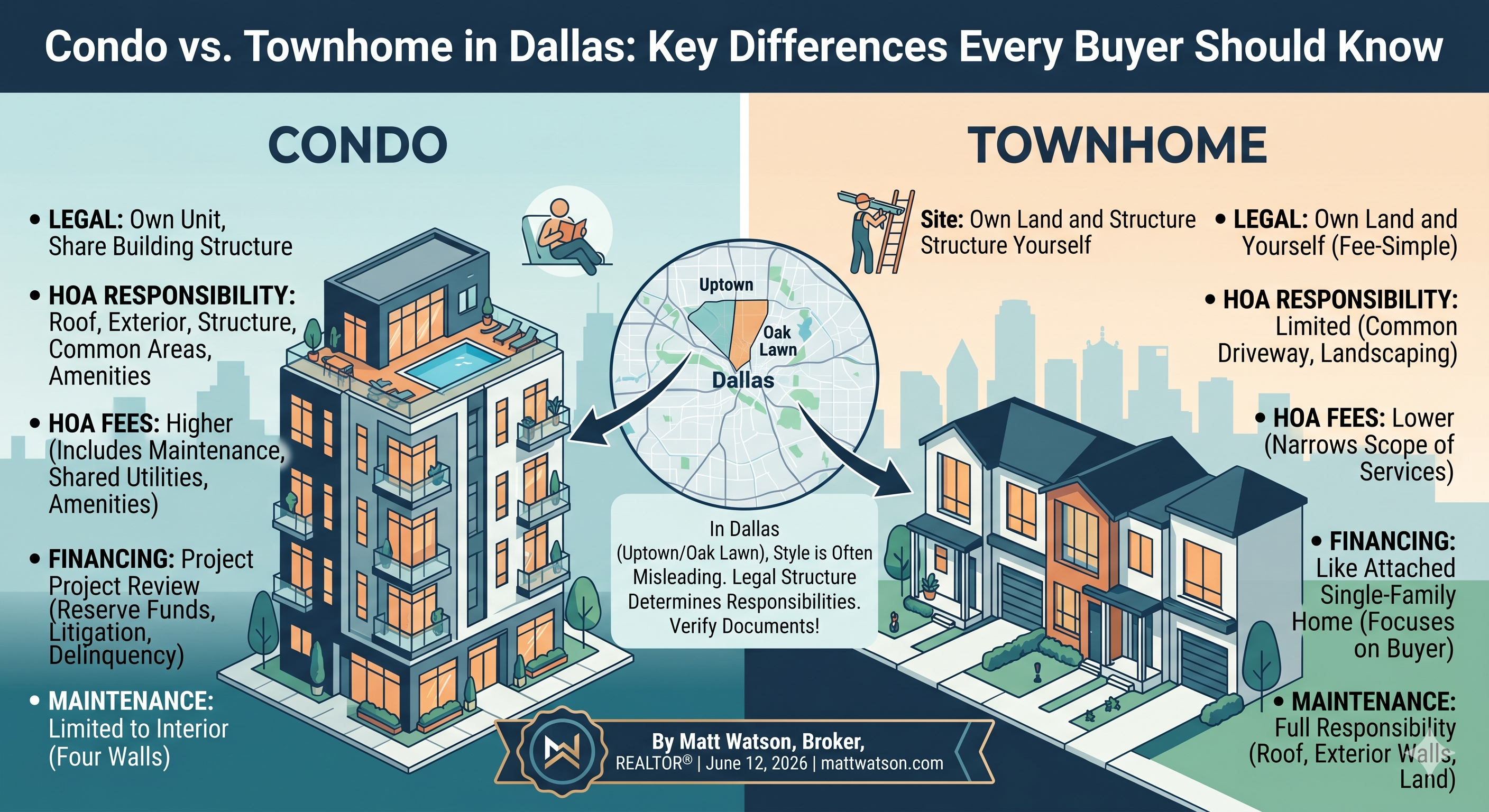
What's the difference between a condo and a townhome in Dallas?
In Dallas, a condo is a legal form of ownership where you own your unit and share an interest in the building's common areas, with the HOA responsible for the structure and exterior. A townhome describes a style of attached, multi-floor home — but it may be legally organized as either a condo or a fee-simple property where you own the land and structure yourself. The difference determines your HOA fees, how your financing works, who handles exterior maintenance, and what your insurance needs to cover. In Uptown and Oak Lawn, many properties listed as "townhomes" are actually condos — always verify the governing documents before making an offer.
By Matt Watson, Broker, REALTOR® | June 12, 2026
When you're browsing Zillow or Redfin for homes in Uptown or Oak Lawn, you'll see the same types of properties labeled different things. A multi-story attached home with a private entrance and a garage might be listed as a "condo." The unit next door, nearly identical, might be listed as a "townhome." Sometimes they're in the same building.
This isn't a listing error. It's a reflection of real confusion that exists in Dallas's urban core market — and it matters more than you might think.
The legal structure of what you're buying affects your monthly costs, your financing options, your insurance coverage, and who pays for the roof when it starts leaking. Getting this wrong isn't just a paperwork issue. It's a financial one.
How a Condo and a Townhome Are Actually Different
The word "townhome" describes a style of home. It's typically multi-floor, attached to neighboring units, with a private entrance, often a garage on the ground floor, and living space above. That description applies to hundreds of properties in Uptown, Oak Lawn, and East Dallas.
The word "condo" describes a legal form of ownership. In a condominium, you own your unit and hold an undivided interest in the shared building components — the roof, the structure, the hallways, the common areas. The HOA holds and manages those shared components on behalf of all the owners.
Here's where Dallas buyers get tripped up: a townhome-style property may be organized as a condominium. It looks like a townhome. It has stairs, a garage, and neighbors sharing walls. But legally it's a condo — and that changes how the association is structured, how the property is financed, and what you're responsible for maintaining.
The other possibility is a fee-simple townhome, where you own the land beneath your unit and the entire structure, not just the airspace inside. The HOA in this case handles limited common areas: a shared driveway, landscaping, maybe a gate. The exterior walls and the roof? That's yours.
You can't tell which one you're looking at from the listing photos. You have to look at the legal documents.
When you're under contract, the seller will provide the governing documents: the Declaration, the bylaws, and the condo plat (if applicable). If the Declaration establishes a "condominium regime," you're buying a condo regardless of what the listing called it. Your agent should be pulling and reviewing these documents during the option period — before your earnest money is truly at risk.
What Changes Based on the Ownership Structure
Once you know what you're actually buying, the financial picture comes into focus.
HOA fees
In Uptown and Oak Lawn, condo HOA fees run from roughly $200 to $1,200 or more per month, depending on the building. A full-service luxury high-rise with a doorman, concierge, valet parking, pool, and gym lands on the higher end. A smaller boutique mid-rise with fewer amenities might run $250 to $400. Fees cover exterior maintenance, building insurance for the structure, elevators, and shared utilities.
Fee-simple townhome HOAs typically run $100 to $400 per month and cover a much narrower scope: landscaping, a shared driveway, maybe common-area pest control. You're not paying for someone to maintain a lobby or repair an elevator because those don't exist.
If a property is listed as a "townhome" but is actually organized as a condo regime, its HOA fees will look more like a condo than a fee-simple property. The governing documents will tell you what the association covers.
Financing
This is the difference that catches the most buyers off guard, especially when comparing similar-looking properties side by side.
With a fee-simple townhome, lenders treat the property like an attached single-family home. The underwriting process focuses on your credit, income, and assets. It's relatively straightforward.
With a condo — whether it's labeled a condo or listed as a townhome but legally organized as one — the lender reviews the entire project, not just your unit. They're evaluating the HOA's financial health, the reserve fund balance, the owner delinquency rate, whether there's active litigation against the association, and the owner-occupancy ratio in the building. If the building doesn't meet Fannie Mae, Freddie Mac, FHA, or VA criteria, your conventional financing options may be limited or unavailable entirely.
I've covered what makes a condo warrantable vs. non-warrantable in detail if you want to dig into the eligibility criteria. But the short version is this: before you fall in love with a unit, verify the building is approved for the loan type you're planning to use. Your lender should run a condo eligibility check early in the process, not after you've waived your option.
Maintenance and insurance
In a condo, the HOA's master insurance policy covers the building's structure and exterior. Your individual policy (an HO-6 policy, often called condo insurance) covers your interior finishes, personal belongings, and liability inside your unit. Your personal maintenance responsibility is limited to what's within your four walls.
In a fee-simple townhome, your insurance needs to cover more — the roof, the exterior, the structure. What you're personally responsible for depends on what the HOA master policy covers, so reading those documents carefully is essential before you close.
In a condo-regime townhome, the HOA master policy covers the structure, similar to a traditional condo. But again, you won't know this from the listing — you'll know it from the governing documents.
Which One Is Right for You in Dallas?
This doesn't have a universal answer. It depends on what you're optimizing for.
If you want low personal maintenance responsibility and you're drawn to the walkability and amenities of a full-service building in Uptown, a condominium is likely a natural fit. You'll pay more in monthly HOA fees, but those fees cover more. When the roof needs work, that's the association's problem, not yours.
If you want more control over your property, a private garage you own outright, and lower HOA fees in exchange for handling your own exterior, a fee-simple townhome is worth looking at. East Dallas and North Oak Cliff have more fee-simple attached options than the denser parts of Uptown.
If you're financing with an FHA loan or a VA loan, the condo eligibility question becomes critical early in your search. Some buildings in Dallas's urban core are approved; others aren't. Starting your search knowing your financing type helps you filter for eligible buildings from the beginning.
And if you're working with a specific monthly budget — mortgage plus HOA plus taxes plus insurance — running the total cost comparison matters as much as the purchase price. A condo priced at $375,000 with a $650/month HOA has a very different monthly payment than a fee-simple townhome at the same price with a $200/month HOA. The total cost is what you'll actually live with every month.
For a closer look at what to scrutinize in the HOA documents before you close, see how to navigate HOA fees when buying a condo in Uptown Dallas.
The right move, regardless of property type, is to have a local agent pull the governing documents and the resale certificate early — before you get emotionally invested in a unit that has a problem you didn't know about.
Frequently Asked Questions
Can a townhome in Dallas be legally organized as a condominium?
Yes, and this is one of the most common points of confusion in Dallas's urban core market. The word "townhome" describes a style of home — multi-floor, attached, private entry — not a legal ownership structure. A property listed as a townhome on Zillow or the MLS may be governed by a condominium regime, meaning the HOA owns the common elements and exterior, and your financing will go through condo underwriting. Always request the Declaration and bylaws to confirm the legal structure before making an offer.
What are typical HOA fees for condos vs. townhomes in Uptown Dallas?
Condo HOA fees in Uptown typically range from $200 to $1,200 or more per month depending on the building and its amenities. Fee-simple townhome HOAs are usually $100 to $400 per month covering more limited common areas. The difference reflects what the association is responsible for: a full-service condo building has far more shared infrastructure to maintain than a townhome development with a shared driveway and landscaping.
Is it harder to finance a condo than a townhome in Dallas?
It depends on the property's legal structure. Fee-simple townhomes go through standard single-family underwriting and are generally straightforward to finance. Condos — including properties styled as townhomes but legally organized as condos — require the lender to review the entire project for warrantability. Buildings with low owner-occupancy ratios, underfunded reserves, or active HOA litigation may not qualify for conventional, FHA, or VA financing, which limits your loan options and can affect your interest rate.
Who is responsible for the roof on a condo vs. a fee-simple townhome?
In a condominium, the HOA is responsible for the building's roof, exterior, and structural components. Your individual condo policy covers only the interior. In a fee-simple townhome, you typically own the structure and are responsible for your own roof, though the specific division of responsibility depends on the HOA governing documents — some townhome associations cover exterior components and others do not.
Are there true fee-simple townhomes in Uptown or Oak Lawn?
Yes, though they're less common than condo-regime properties in the densest parts of Uptown. You're more likely to find fee-simple attached homes in parts of Oak Lawn, East Dallas, and North Oak Cliff. In Uptown's core, many townhome-style properties are organized as condominiums. The only way to confirm which you're looking at is to review the Declaration. Your agent should be able to identify this in the documents early in the option period.
The condo vs. townhome question in Dallas isn't really about style — it's about legal structure, and the legal structure drives your monthly costs, your financing options, and your maintenance obligations. In Uptown and Oak Lawn especially, the property that looks like a townhome may be legally a condo, with all the HOA fees and project-level financing requirements that come with it.
If you're shopping for a condo or townhome in Dallas's urban core and want a clear-eyed look at what your total monthly cost would actually be — including property taxes, HOA, insurance, and mortgage — I'm happy to walk through it with you. Reach out at mattwatson.com and we'll figure out which property type fits your situation, your financing, and your budget.
