


Do you pay capital gains tax when selling a home in Dallas, TX?
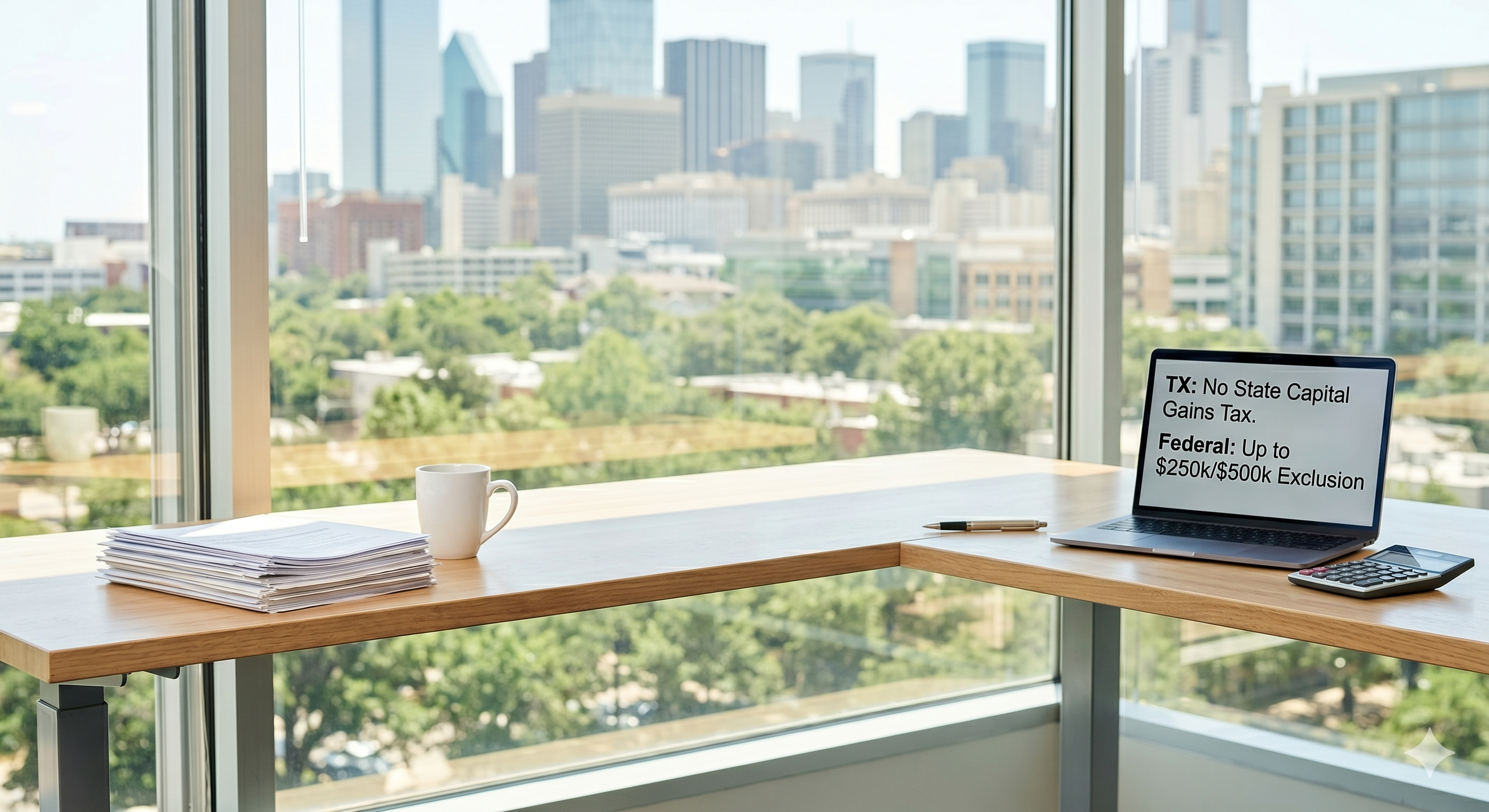
Texas has no state capital gains tax, so Dallas sellers only need to consider federal taxes. Most homeowners qualify for the Section 121 primary residence exclusion, which lets single filers exclude up to $250,000 in profit and married couples exclude up to $500,000. To qualify, you must have owned and lived in the home as your primary residence for at least two of the past five years. If your profit stays within those limits, you owe nothing to the IRS.
By Matt Watson, Broker, REALTOR® | May 22, 2026
The most common question I get from sellers getting ready to list isn't about commissions or closing costs. It's about taxes. Specifically: "Am I going to owe capital gains tax on this?"
For most Dallas homeowners, the answer is no. Here's why, and here's how to know for sure.
Texas Has No State Capital Gains Tax
This surprises a lot of people who've relocated from states like California or New York, where capital gains are taxed at the state level on top of federal taxes. Texas collects no state income tax and no state capital gains tax. When you sell your home in Dallas, the only tax exposure you need to think about is at the federal level.
And even there, the federal tax code gives most homeowners a powerful break.
The Primary Residence Exclusion: How Most Sellers Owe Nothing
Under Section 121 of the federal tax code, single homeowners can exclude up to $250,000 in profit from their home sale. Married couples filing jointly can exclude up to $500,000. That means the first $250,000 or $500,000 of your gain is completely tax-free.
To qualify, you need to meet two tests:
- Ownership test: You've owned the home for at least two years out of the five years before the sale date.
- Use test: You've lived in it as your primary residence for at least two years out of the same five-year window.
The two years don't have to be consecutive. You just need to hit the two-year mark on both counts within that five-year period before you close. And you can only use the exclusion once every two years — so if you claimed it on another home sale within the last two years, you'll need to wait.
Here's the practical reality for most Dallas sellers: if you bought your home three to five years ago, paid a reasonable market price, and are selling today in a market where values have pulled back from their 2022 highs, your net profit after commissions and closing costs is very likely to fall within the exclusion limits. For most sellers in Uptown, Oak Lawn, East Dallas, and North Oak Cliff, there's no federal tax bill waiting at the closing table.
What Actually Counts as Your "Profit"?
This is where a lot of sellers get confused. Taxable gain isn't simply sale price minus purchase price. You can reduce your taxable gain by adding up your adjusted cost basis:
- Your original purchase price
- Closing costs you paid when you bought the home
- Capital improvements (kitchen renovation, HVAC replacement, bathroom addition, new roof — not routine maintenance)
- Selling costs from this transaction: agent commissions, title insurance, escrow fees, and related charges
Here's a concrete example. Say you bought a two-bedroom condo in Oak Lawn four years ago for $380,000. You spent $35,000 on renovations. You're selling for $510,000 and paying roughly $40,000 in selling costs. Your adjusted basis is $380,000 plus $35,000 equals $415,000. Your net taxable gain is $510,000 minus $415,000 minus $40,000, which equals $55,000. If you're single, you're more than $195,000 under the exclusion limit. You owe nothing.
Keep records of what you spent on improvements. They can meaningfully reduce your taxable gain if your profits push toward the exclusion threshold.
When You Might Owe Taxes: Three Situations Worth Knowing
The exclusion doesn't apply in every situation. Here are the cases where capital gains tax can come into play:
1. Short ownership period
If you've owned the home for less than two years, you don't meet the ownership test and can't use the exclusion. And if you've owned it for less than one year total, the gain is taxed as short-term capital gain at your ordinary income rate, which can reach 37% for higher earners. This matters for anyone who bought recently and is now facing a life change that requires a quick sale.
2. Investment properties and rental condos
The Section 121 exclusion is specifically for primary residences. If you've been renting out your Dallas condo rather than living in it as your home, you don't automatically qualify. You may still be eligible if you lived in the property as your primary residence for at least two of the past five years, but there's an additional complication: depreciation recapture. Any depreciation deductions you claimed while renting the property out get taxed at a rate up to 25% when you sell, regardless of the exclusion. A CPA who works with real estate sellers should run those numbers before you list.
3. Large gains that exceed the exclusion limits
If you bought a condo in Uptown or a townhome in East Dallas ten years ago at a significantly lower price and have seen substantial appreciation, your gain could push past $250,000 (single) or $500,000 (married). Any gain above the exclusion amount is subject to federal long-term capital gains tax:
- 0% — taxable income under $49,450 (single) or $98,900 (married filing jointly) in 2026
- 15% — the rate that applies to most middle-income sellers
- 20% — applies to higher-income households
There's one more layer for high earners: the Net Investment Income Tax (NIIT), a 3.8% surtax that applies to individuals with modified adjusted gross income above $200,000 (single) or $250,000 (married). If your income puts you in that bracket, the 3.8% applies to any gains above the exclusion amount, stacked on top of the capital gains rate.
This isn't a common situation for most Dallas sellers — but it's not rare for people who've held high-value properties in neighborhoods with strong appreciation over the last decade. If you think your gain might exceed the exclusion, model it with your CPA before you list.
One Thing Capital Gains Tax Is Not
Many sellers confuse capital gains tax with property tax proration, which is a separate line item at closing. When you sell your Dallas home, you'll owe the portion of the year's property taxes covering the time you owned the property. That's a closing cost, not a capital gains issue. If you want to understand how that works, this post walks through property taxes when selling a Dallas home in detail.
And capital gains tax is just one piece of the net proceeds picture. Agent commissions, title insurance, the Texas title company fees, and any seller concessions you agreed to all factor into what you actually walk away with. For a full breakdown of those numbers, What Will You Net Selling Your Dallas Home? The Real 2026 Numbers runs through the complete math.
The Bottom Line for Dallas Sellers
If you've lived in your home as your primary residence for at least two years and your profit is under $250,000 (single) or $500,000 (married), you owe nothing in capital gains tax. Texas removes the state layer entirely, and the federal exclusion handles the rest for the vast majority of sellers.
Where it gets more complex: if you owned the home for less than two years, if you've been renting it out, or if you've seen extraordinary appreciation that pushes your gain past the exclusion limits. Those are the situations worth reviewing with a tax professional before you go to market.
After 25 years of helping Dallas sellers understand exactly what they'll keep, I can tell you that taxes are rarely the surprise people fear. What's more likely to affect your net is pricing strategy, timing, and the closing cost structure — which is exactly what I walk my clients through before we list.
Every situation is a little different, and the only way to know your specific number is to run the math. That's a conversation I'm happy to have.
Frequently Asked Questions
Does Texas have a state capital gains tax on home sales?
No. Texas has no state income tax and no state capital gains tax. If you sell your Dallas home, your only potential tax obligation is at the federal level — and most homeowners owe nothing there either, thanks to the primary residence exclusion.
How long do I need to live in my home to avoid capital gains tax?
You need to have owned and lived in the home as your primary residence for at least two of the five years before the sale date. The two years don't have to be consecutive — they just need to fall within that five-year window before you close.
What is the capital gains tax rate on home sales in Texas in 2026?
Most sellers owe nothing, thanks to the $250,000 (single) or $500,000 (married filing jointly) primary residence exclusion. If your gain exceeds those limits, long-term federal capital gains rates for 2026 are 0%, 15%, or 20%, depending on your total taxable income. Texas itself collects no state capital gains tax.
What if I've been renting out my Dallas condo — do I still get the exclusion?
Not automatically. The Section 121 exclusion applies to your primary residence. If you've rented the property, you may still qualify if you lived in it as your primary home for at least two of the last five years, but you'll also likely face depreciation recapture tax on the rental period. A CPA who works with real estate sellers can calculate your specific liability.
Can home improvements reduce my capital gains tax in Texas?
Yes. The cost of permanent improvements — renovations, additions, new HVAC, new roof — gets added to your adjusted cost basis, which lowers your taxable gain. Selling costs like agent commissions and title fees also reduce your gain. Keep records of what you spent on improvements. Routine maintenance, painting, and cleaning do not count.
If you're thinking about selling your Dallas home and want to understand exactly what you'll net — including how capital gains tax fits into the picture — I'm happy to put together those numbers with you. I've spent over 25 years helping sellers in Uptown, Oak Lawn, East Dallas, and North Oak Cliff get a clear view of their transaction before we list. No pressure, no obligation. Reach out at mattwatson.com to schedule a free consultation.
:format(webp):quality(80)/u.realgeeks.media/mattwatson/agent_pic_sidebar.jpg "Agent Matt Watson")