 How do you buy and sell a home at the same time in Texas?
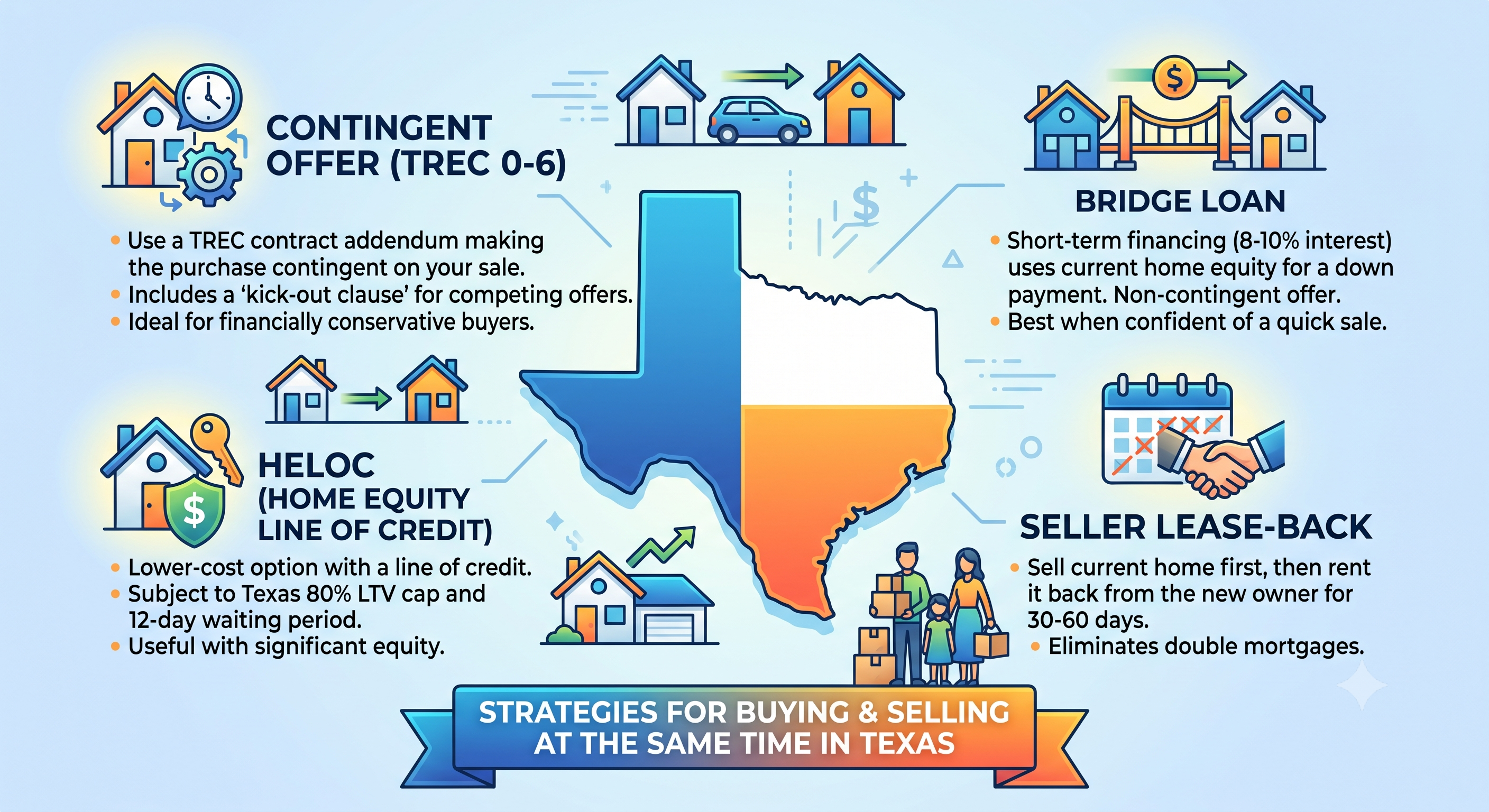
In Texas, buyers who need to sell their current home before closing on a new one have four main options: a contingent offer using the TREC Addendum for Sale of Other Property (Form 10-6), a bridge loan (short-term financing at 8–10% interest), a home equity line of credit (HELOC, subject to Texas constitutional limits), or a seller lease-back arrangement after their current home closes. The right strategy depends on your equity position, how quickly your departure home is likely to sell, and how much financial risk you can absorb during the overlap. In Dallas's 2026 buyer's market, where homes in Uptown and Oak Lawn are averaging around 59 days on market, timing coordination matters more than it has in years.
By Matt Watson, Broker, REALTOR® | July 1, 2026
Moving up in Dallas is one of the most common situations I work through with clients right now. You've found the next place. You love it. And you can't afford to own both homes at once. Or maybe you technically could, but not for long.
What makes this tricky in Texas is that you're navigating two separate contracts, two separate timelines, and a legal framework that adds some rules most national advice leaves out. Let's go through your four main options and what each one actually costs you in time, money, and risk.
Your Four Options
Option 1: Contingent Offer (TREC Form 10-6)
The most financially conservative path is making your purchase contingent on selling your current home first. Texas has a specific contract addendum for this: the Addendum for Sale of Other Property by Buyer (TREC Form 10-6). Your agent fills in your current property address, a contingency deadline, and the kick-out clause terms.
The kick-out clause is the part most buyers don't fully understand. Once a seller accepts your contingent offer, they can keep marketing the home. If another buyer comes in with a clean offer, the seller sends you written notice — typically giving you 72 hours to either waive the contingency and commit to buying without your sale, or release the contract and get your earnest money back. It's not a guarantee you lose the house. It's a forced decision point.
One rule that trips people up: most sellers in Dallas won't accept a contingent offer unless your current home is already active on the MLS. If you're planning to go this route, get your home listed before you start submitting offers on the next one.
In Dallas's 2026 buyer's market, contingent offers are more viable than they've been in several years. Sellers in Uptown and Oak Lawn are sitting on inventory longer and are generally more open to negotiating terms. But if you're targeting a well-priced property where two or three buyers are looking at the same time, a contingent offer will usually lose to a clean one.
Option 2: Bridge Loan
A bridge loan is short-term financing that uses the equity in your current home as collateral. You borrow against what you own to fund the down payment on the new home, then repay the bridge loan when your current home sells. The advantage: your offer on the new home is clean, not contingent.
The math works, but it isn't cheap. Bridge loans in Texas are running 8% to 10% interest in mid-2026, with origination fees of 1.5% to 3% of the loan amount. Terms are typically 6 to 12 months. Most lenders require at least 20% equity in your current home, and most want it listed before they'll fund.
Here's a real example. Say your current home is worth $500,000 and you owe $250,000. You want to borrow $150,000 as a bridge to fund the down payment on the next place. At 9% interest for six months, that's roughly $6,750 in interest, plus $2,250 to $4,500 in origination fees. You're paying $9,000 to $11,000 to make a non-contingent offer.
Whether that's worth it depends on how much competition you expect on the purchase side, and how confident you are your current home sells within six months. Given that Oak Lawn and Uptown are running 59-day average market times right now, budget accordingly.
Option 3: HELOC (Home Equity Line of Credit)
If you have significant equity and some runway before you need to move, a HELOC is a lower-cost alternative to a bridge loan. You open a line of credit against your current home's equity, draw from it for the down payment on your next purchase, then repay it after you close on your sale.
Texas has some of the strictest home equity rules in the country, and they apply here. Under Article XVI, Section 50 of the Texas Constitution:
- All home equity debt on your primary residence — your original mortgage plus the HELOC — cannot exceed 80% of your home's appraised value
- There's a mandatory 12-day waiting period between application and funding
- You can only have one home equity loan or HELOC at a time on your Texas homestead
The 80% combined loan-to-value cap is the one that limits people most. If you owe $350,000 on a $500,000 home, your maximum total home equity borrowing is $50,000 ($500K × 80% = $400K, minus $350K already owed). If $50,000 isn't enough for a meaningful down payment on the next home, the HELOC may not solve the problem.
The upside: HELOC interest rates are significantly lower than bridge loan rates, and if you draw and repay quickly, the total cost is much lower than a bridge.
One more timing note: the 12-day waiting period is mandatory. You can't waive it. If you need funding quickly for a purchase, account for that gap in your planning.
Option 4: Seller Lease-Back
A lease-back flips the sequence. You sell your current home first, then negotiate a short-term lease with your buyer that lets you stay in the property for 30 to 60 days while you finalize your next purchase.
This approach eliminates the double-mortgage problem entirely. You close, you receive your proceeds, and you use them for the down payment on the next home while continuing to live where you are through the transition period.
The risk lands on the purchase side. If you're buying in a sub-market where the home you want might not wait 30 to 60 days, you could sell your current home without a clear landing spot. You'll want the lease-back terms documented in writing — rent amount, security deposit, what happens if your next closing is delayed.
In Dallas's current market, buyers are generally open to lease-backs. Many sellers in Uptown and Oak Lawn are offering them as a negotiating concession. If you're in that position, it can actually make your listing more appealing because it signals you're a motivated seller who has a plan.
The Simultaneous Close: When Both Transactions Happen the Same Day
The cleanest version of all of this is coordinating both closings on the same day. You close on your current home in the morning, the funds wire over, and you close on the new home in the afternoon. You walk out of the title company with keys.
This requires your agents, your lender, and both title companies to communicate tightly from the beginning. Your purchase lender needs to be prepared to fund once your sale proceeds clear. It's doable and it happens regularly in Dallas, but it requires planning from the moment you go under contract on your departure home. If either closing runs into a delay, the other one can cascade.
This is exactly the situation where having one agent coordinating both sides saves you a lot of stress. I've handled a number of these for clients in Uptown, Oak Lawn, East Dallas, and North Oak Cliff. The mechanics aren't magic, they're just coordination.
What Goes Wrong (And How to Avoid It)
The most common mistake: overpricing the departure home. In 2026, I still see sellers anchoring their price to 2022 peak comps. That's not what the market is paying today. Uptown and Oak Lawn condos and townhomes are averaging 59 days on market, and price reductions are common. If your strategy assumes your current home sells in three weeks, build in a significant buffer.
The second most common mistake: skipping a pre-listing inspection on your current home. If the buyer's inspector surfaces a foundation problem or a roof issue, your closing gets delayed. When two transactions are running in parallel, a delay on one side can trigger rate lock expirations, missed contract deadlines, and lost earnest money on the other side. A pre-listing inspection typically costs $300 to $500 and saves you from that scenario.
The third mistake is rounding errors on proceeds. Before you pick a strategy, you need to know what you'll actually net from your current sale after commissions, title fees, tax prorations, and any concessions to the buyer. That net number is what you're working with for your next down payment. If you're estimating, you might be planning around money you won't actually have. For the full breakdown on what sellers in Dallas typically walk away with, this post on what you'll net selling your Dallas home in 2026 walks through the real numbers.
Getting the Numbers Right Before You Decide
Before you commit to any strategy, you need an honest current market analysis on your departure home. Not a Zestimate. Not a price your neighbor got two years ago. A real look at what homes like yours in your specific Dallas neighborhood are selling for right now and how long they're taking to go under contract.
That number drives everything: which financing strategy makes sense, what contingency deadline to request in your purchase offer, and how much timing risk you're actually taking on. For buyers using seller concessions on the purchase side to help with closing costs, this post on seller concessions in Dallas for 2026 covers how to structure that ask once you have a home under contract.
Every situation is different. The right move for someone with $300,000 in equity and a fast-moving departure home looks completely different than the right move for someone with $80,000 in equity and a condo that needs work. The only way to know which strategy fits is to run the actual numbers.
Frequently Asked Questions
Does a contingent offer mean I'll lose the house if another buyer shows up?
Not necessarily. The kick-out clause gives you a window — typically 72 hours in Texas — to waive the contingency and commit to buying without the sale of your current home. If you have a bridge loan or HELOC pre-arranged, you can drop the contingency quickly when the notice arrives. If not, you release the contract and receive your earnest money back in full.
How much equity do I need to use a HELOC or bridge loan in Texas?
For a HELOC, Texas law caps all home equity debt at 80% of your home's appraised value. You need enough equity above your current mortgage balance to borrow a useful amount. For a bridge loan, most lenders require at least 20% equity. Most move-up buyers in Dallas's urban core who have owned for three or more years have enough equity to qualify for one or both options.
Can I use the proceeds from my home sale to close on the new one the same day?
Yes, and it happens regularly in Dallas. Both title companies coordinate the wire transfers, and your purchase lender needs to be prepared to fund once your sale proceeds clear. It requires communication between all parties from the beginning, but a same-day closing is the cleanest outcome when it comes together.
What is the TREC Addendum for Sale of Other Property?
It's TREC Form 10-6, the official Texas contract addendum that makes your purchase offer contingent on selling your current home first. It specifies your current property address, the deadline by which your home must sell, and the kick-out clause terms — typically giving the seller the right to send a 72-hour notice if another offer arrives. Your agent fills it out and attaches it to your purchase offer.
How long does it take to close on both homes in Dallas?
A typical Dallas contract-to-close runs 30 to 45 days for a financed purchase. For simultaneous closings, both timelines need to align. The most common challenge is the departure home taking longer to sell than expected. In Uptown and Oak Lawn's current market, budget 45 to 75 days for your current home to go from listing to closed.
Buying and selling at the same time in Texas is manageable — the complexity is real, but it's the kind that planning and good coordination can handle. The biggest risk isn't the paperwork. It's going in without an accurate picture of your departure home's value and timeline in today's market.
If you're working through this move, I'd be glad to put together a free market analysis on your current home and walk through which of these strategies makes sense for your situation. No pressure, no obligation — just real numbers from someone who knows these neighborhoods. Reach out at mattwatson.com.
About Matt Watson, Broker, REALTOR®
Matt Watson is a Dallas-based real estate broker and REALTOR® with over 25 years of experience in the city's urban core neighborhoods. He specializes in condos, townhomes, and single-family homes in Uptown, Oak Lawn, East Dallas, and North Oak Cliff. Whether you're buying your first condo or selling a longtime home, Matt brings deep local knowledge and straightforward guidance to every transaction. Connect with Matt at mattwatson.com.
