


What Is the Texas Homestead Exemption and How Much Does It Save Dallas Homeowners?
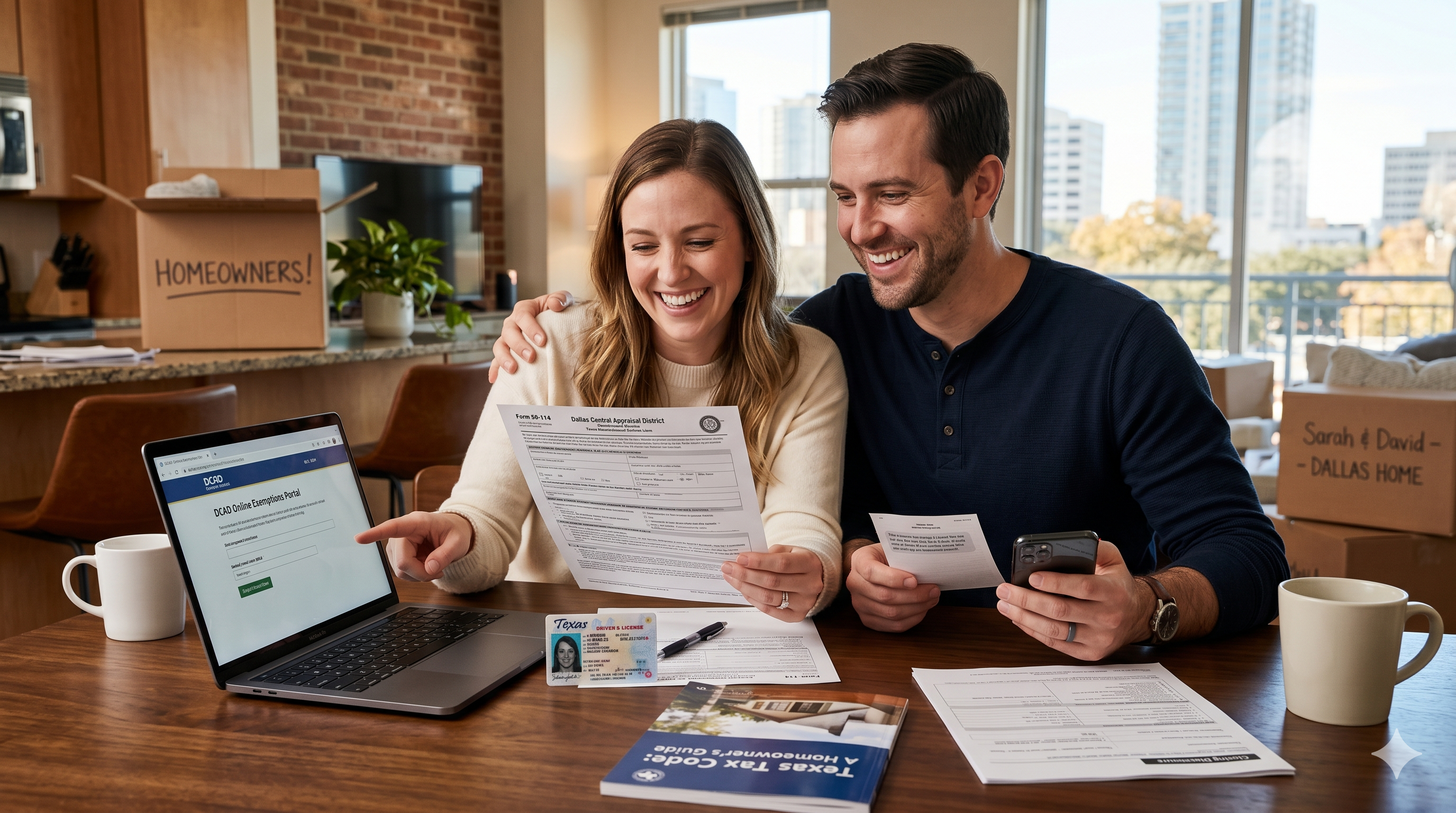
The Texas homestead exemption reduces the taxable value of your primary residence for property tax purposes. In Dallas, most homeowners save an average of $1,763 per year — and when you factor in the layered exemptions from the City of Dallas, Dallas County, Dallas College, and Parkland Hospital District, total annual savings often reach $2,000 to $4,500 depending on your home's value. The exemption is not automatic. You must file Form 50-114 with the Dallas Central Appraisal District (DCAD) yourself.
By Matt Watson, Broker, REALTOR® | May 1, 2026
One of the most expensive mistakes Dallas homeowners make isn't paying too much for the house. It's not knowing about this form.
When you close on a home in Texas, your title company handles a mountain of paperwork. Your lender walks you through loan documents. But in most closings, nobody hands you a form from the Dallas Central Appraisal District and says, "File this the day you move in."
That form is the Texas Homestead Exemption application, and skipping it costs the average Dallas homeowner $1,763 every single year.
If you just bought a home in Uptown, Oak Lawn, East Dallas, North Oak Cliff, or anywhere else in Dallas County, here's everything you need to know about what the exemption does, how much it saves you, and how to file it today.
What the Exemption Actually Does — And How Much You Save in Dallas
Texas doesn't have a state income tax. That tradeoff shows up in your property tax bill, which is paid to multiple overlapping entities: Dallas ISD, the City of Dallas, Dallas County, Dallas College, and Parkland Hospital District. When you combine all of those rates, most homeowners in the City of Dallas pay approximately 2.22% of taxable value per year. On a $450,000 condo in Oak Lawn, that's roughly $9,990 per year before any exemptions.
The homestead exemption reduces your taxable value, which reduces your bill.
Here's what Dallas homeowners qualify for in 2026:
- $140,000 school district exemption — this is the big one. It was increased from $100,000 when Texas voters approved Prop 13 in November 2025. It applies only to the school district portion of your bill.
- 20% exemption from the City of Dallas — reduces your taxable value by 20% for city tax purposes.
- 20% exemption from Dallas County — same structure, applied to the county's rate.
- 20% exemption from Dallas College — reduces the community college district portion.
- 20% exemption from Parkland Hospital District — reduces the hospital district portion.
If you're over 65 or have a qualifying disability, you get an additional $60,000 school district exemption on top of the base $140,000, bringing your total school district reduction to $200,000.
What does that mean in dollars?
On a $450,000 home in Dallas, the $140,000 school district exemption means you pay school taxes as if the home were worth $310,000 instead. The 20% exemptions on city, county, and district portions reduce your taxable value for those entities as well. When all of it layers together, the average Dallas homeowner saves around $1,763 to $4,500 per year, depending on their home's appraised value.
That's money you're leaving on the table every year you don't file.
If you're thinking about how property taxes factor into your full picture as a Dallas homeowner, my post on what homeowners insurance covers and costs in Dallas walks through the other major ongoing ownership costs — it pairs well with understanding your full monthly payment.
How to File Your Homestead Exemption with DCAD
Filing is free, takes about ten minutes, and you can do it online. Here's the process step by step.
Step 1: Update your Texas driver's license (and vehicle registration).
Texas law requires your driver's license address to match your new property address. Furthermore, DCAD routinely checks your vehicle registration receipt to ensure it matches as well. If you don't own a vehicle, you'll just need to sign an affidavit stating that on the application. Head to the DPS office or update online at txdps.state.tx.us before you file.
Step 2: Go to dallascad.org and look up your property.
Navigate to the DCAD website and use the property search tool to find your home by address or owner name. You'll see your account number, which you'll need for the application.
Step 3: Complete Form 50-114.
This is the Application for Residence Homestead Exemption. You can download it directly from the Texas Comptroller's website or from DCAD. The form asks for your property address, account number, the date you started using the home as your primary residence, and a copy of your Texas driver's license showing the matching address.
DCAD also accepts online submissions through their portal at dallascad.org. If you file online, you'll upload a copy of your driver's license as part of the process.
Step 4: Submit as soon as you close.
The official priority deadline to ensure your exemption is applied to your initial fall tax bill is April 30. However, you do not need to wait. Thanks to recent Texas law changes, if you buy your home mid-year, you can apply immediately and receive a prorated (partial-year) exemption for the remainder of that calendar year, provided the previous owner didn't already have a homestead exemption active on it.
What if you already missed it?
Texas Tax Code Section 11.431 allows you to file retroactively for up to two years. If you bought your home in 2024 or 2025 and never filed, you can still recover those overpaid taxes. On the Form 50-114, check "Yes" for late application and enter the first year you believe you qualified. DCAD will process it, recalculate your tax bill, and either apply a credit or issue a refund.
The Homestead Cap — The Benefit Most People Don't Know About
The exemption saves you money on your current tax bill by lowering your taxable value. But the homestead cap may be worth even more over time.
Once your homestead exemption is officially on file, Texas law places a hard limit on how much your property's taxable assessed value can increase each year. No matter how hot the Dallas market gets, your taxable assessed value cannot jump by more than 10% per year (plus the value of any new major improvements you make, like adding a pool).
This is a massive shield in urban core neighborhoods like Uptown, Oak Lawn, or East Dallas, where rapid market appreciation can otherwise cause property tax bills to spike dramatically.
Here is the critical detail: while your actual tax dollar discounts can start mid-year via a prorated exemption, the 10% valuation cap protection does not lock in until January 1 of the year after you have lived in the home as your primary residence on January 1.
Let’s look at the math timeline:
-
The Best Case Scenario: If you buy your home in February 2026 and file your exemption immediately, you get prorated tax savings for 2026. Because you will officially occupy the home on January 1, 2027, your 10% cap protection locks in and officially takes effect on January 1, 2028.
-
The Dangerous Mistake: If you delay and don't get around to filing until November or December of 2026, you haven't technically lost your 2027 cap eligibility—but you have set yourself up for a financial headache. When Dallas County sends out the initial tax bills in October, your property will be billed at the full, un-exempted rate. You will be forced to pay an inflated bill upfront to avoid late penalties, and then wait months for the appraisal district to process your paperwork and mail you a refund check.
For buyers picking up condos or townhomes in Uptown or Oak Lawn where values continue to climb, this cap is your absolute best friend. You want to lock in your taxable trajectory as fast as humanly possible before the next county appraisal cycle hits.
If you're still sorting out the financial pieces of owning a condo in Dallas, it's also worth reviewing what buyers need to know about HOA fees in Uptown Dallas — those monthly fees work differently from property taxes, but understanding both together gives you a complete picture of what ownership actually costs.
And if you're a seller trying to understand how property taxes factor into your closing, my post on property taxes when selling a Dallas home covers how prorated taxes are handled between buyer and seller at the title company.
If you're still sorting out the financial pieces of owning a condo in Dallas, it's also worth reviewing what buyers need to know about HOA fees in Uptown Dallas — those monthly fees work differently from property taxes, but understanding both together gives you a complete picture of what ownership actually costs.
And if you're a seller trying to understand how property taxes factor into your closing, my post on property taxes when selling a Dallas home covers how prorated taxes are handled between buyer and seller at the title company.
Frequently Asked Questions
Does the Texas homestead exemption apply to condos and townhomes?
Yes. The homestead exemption applies to any property you own and use as your primary residence in Texas, including condos and townhomes. The filing process through DCAD is the same regardless of property type.
What happens if I don't have a Texas driver's license with my new address yet?
You need to update your Texas driver's license to show your property address before DCAD will approve the exemption. This is a firm requirement. Update your license at a DPS office or online at txdps.state.tx.us, then file your exemption application once the update is processed.
Can I file the homestead exemption on more than one property?
No. You can only claim a homestead exemption on one property in Texas — the one you use as your primary residence as of January 1 of the tax year. If you own multiple properties, only your principal home qualifies.
What if I bought my home in the middle of the year — do I qualify for the exemption for that year?
Yes! Texas allows for prorated homestead exemptions. If you buy your home in April or August, you qualify for the exemption for the remaining months of that year (assuming the prior owner hadn't already claimed a homestead exemption on it for that year). You should file immediately after closing to get your savings started and ensure your 10% appraisal cap protection is set to lock in on January 1st of the following year.
How long does it take DCAD to process the homestead exemption?
DCAD typically processes applications within four to six weeks during peak filing season (January through April). You should receive a confirmation notice. If you file online, you can track your application status through the DCAD portal.
Filing the homestead exemption is one of the most straightforward things you can do to reduce your property tax bill as a Dallas homeowner, and it's one of the most commonly missed steps in the buying process. The $140,000 school district exemption alone can save you hundreds of dollars per year, and the 10% cap protection is worth even more over the long run.
If you have questions about property taxes, ownership costs, or what to expect as a buyer or seller in Dallas's urban core, I'm happy to walk through it with you. Reach out at mattwatson.com for a no-pressure consultation — no obligation, just straight answers from someone who's been working these neighborhoods for 25 years.
About Matt Watson, Broker, REALTOR®
Matt Watson is a Dallas-based real estate broker and REALTOR® with over 25 years of experience in the city's urban core neighborhoods. He specializes in condos, townhomes, and single-family homes in Uptown, Oak Lawn, East Dallas, and North Oak Cliff. Whether you're buying your first condo or selling a longtime home, Matt brings deep local knowledge and straightforward guidance to every transaction. Connect with Matt at mattwatson.com.
:format(webp):quality(80)/u.realgeeks.media/mattwatson/agent_pic_sidebar.jpg "Agent Matt Watson")