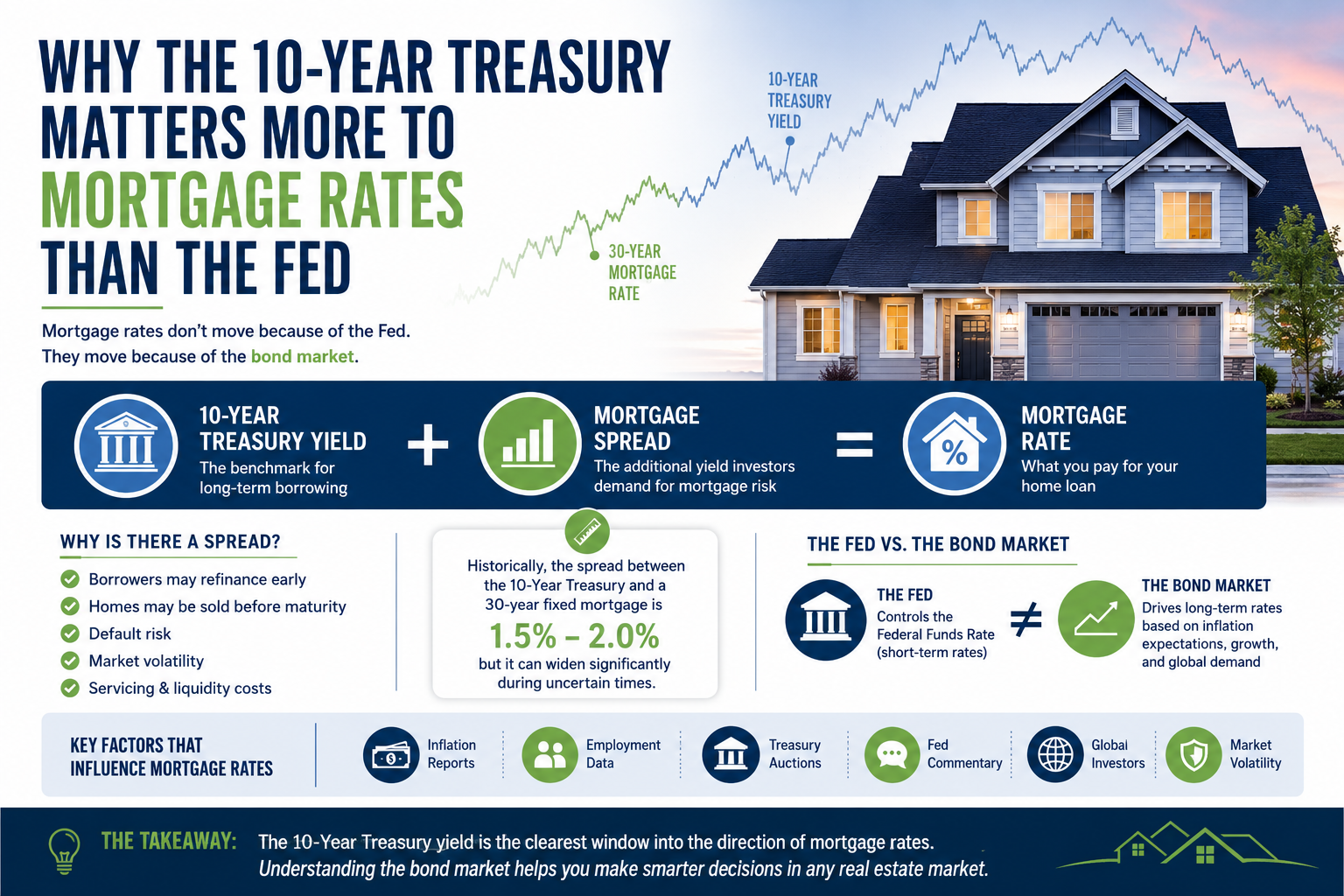
What actually controls mortgage rates? Mortgage rates are not set by the Federal Reserve. They're driven primarily by the yield on the 10-Year U.S. Treasury note, which means rates can move even when the Fed does nothing at all.
If you've been waiting on the Fed to cut rates before buying a home in Uptown, Oak Lawn, or anywhere else in Dallas, this is worth understanding before you make that call.
The Fed Gets the Headlines, But the Bond Market Moves Rates
Every time the Federal Reserve makes a move, the headlines follow. "The Fed raised rates." "The Fed cut rates." It sounds like mortgage rates should respond immediately. The reality is more complicated.
The Fed controls the Federal Funds Rate, which is the overnight lending rate between banks. That rate has a direct effect on things like credit cards, home equity lines of credit, and short-term loans. Long-term mortgage rates are a different story.
Thirty-year fixed mortgage rates are driven by the bond market, specifically the yield on the 10-Year U.S. Treasury note. Those are two very different things, and confusing them leads buyers to make decisions based on news that may not actually affect their monthly payment.
Why the 10-Year Treasury?
Investors who buy mortgage-backed securities are essentially competing with investors who buy U.S. Treasury bonds. Both are looking for a return on their money.
When Treasury yields rise, mortgage-backed securities have to offer higher returns to stay competitive. That pushes mortgage rates up. When Treasury yields fall, mortgage rates often follow.
The basic formula works something like this:
Mortgage Rate = 10-Year Treasury Yield + Mortgage Spread
The "spread" is the extra return investors require for taking on risks that don't exist with Treasury bonds. Mortgages carry risks like borrowers refinancing early, homes being sold before the loan matures, and potential defaults. Because of that additional risk, investors demand more yield.
Historically, that spread between the 10-Year Treasury and a 30-year fixed mortgage has typically ranged from about 1.5% to 2.0%. When uncertainty increases — during periods of high inflation, banking instability, or rapid Fed policy shifts — that spread can widen, which keeps mortgage rates elevated even when Treasury yields start to come down.
Why Rates Can Rise After a Fed Cut
This is the part that surprises most people.
Mortgage rates can actually increase after the Fed cuts its benchmark rate. That happens because the bond market is forward-looking. Investors are not reacting to what happened yesterday. They're pricing in what they expect to happen months from now.
If a Fed rate cut signals that inflation might pick back up, bond investors may demand higher yields to protect against that risk. When Treasury yields move higher, mortgage rates follow. The Fed cut, but rates went up anyway.
It's counterintuitive, but it happens. And it's one reason why waiting for a Fed cut as a mortgage rate strategy doesn't always work the way buyers expect.
What Actually Moves Mortgage Rates Day to Day
Mortgage professionals are not watching the Federal Funds Rate hour by hour. The real-time indicators that matter most are:
- 10-Year Treasury yields: The most accessible public benchmark for tracking mortgage rate direction
- Inflation data: CPI and PCE reports regularly move the bond market, sometimes dramatically
- Employment reports: Strong job numbers can push yields higher; weak numbers can pull them lower
- Federal Reserve commentary: Statements and press conferences shift investor expectations even without an actual rate change
- Treasury auctions: When the government issues new debt, supply and demand dynamics affect yields
- Global investor sentiment: When global uncertainty rises, investors often move into U.S. Treasuries, which can push yields down and bring some relief to mortgage rates
Rates move every trading day. Sometimes multiple times in a single day. Trying to time the market perfectly is nearly impossible, even for professionals.
Why This Matters If You're Buying in Dallas
For buyers in Uptown, Oak Lawn, East Dallas, or North Oak Cliff, even a small shift in mortgage rates has a real impact on affordability.
A 0.5% change in interest rate can shift purchasing power by tens of thousands of dollars. On a $500,000 home, that's not a rounding error. It changes what you qualify for, what your monthly payment looks like, and how competitive you can be when making an offer.
For sellers, rate movement explains why buyer demand can shift quickly from one month to the next. It's not always about the price of your home. Sometimes it's a CPI report that came in hotter than expected.
And for anyone thinking about refinancing, watching Treasury yield trends can give you a better read on where rates are heading than waiting for a Fed announcement.
FAQ
Does the Federal Reserve directly set mortgage rates? No. The Fed sets the Federal Funds Rate, which primarily affects short-term borrowing like credit cards and home equity lines of credit. Thirty-year fixed mortgage rates are tied more closely to the 10-Year Treasury yield and the broader bond market.
Why are mortgage rates higher than Treasury yields? Mortgage-backed securities carry risks that Treasury bonds don't, including borrower prepayment, default risk, and market volatility. Investors demand higher returns for those risks, which is why mortgage rates typically run 1.5% to 2.0% above the 10-Year Treasury yield under normal conditions.
If Treasury yields are falling, why aren't mortgage rates dropping too? Sometimes the spread between Treasury yields and mortgage rates widens during periods of uncertainty. If investors are nervous about inflation, prepayment risk, or bond market volatility, they require more yield to hold mortgage-backed securities. That keeps rates elevated even when the underlying Treasury yield is falling.
If you're thinking about buying or selling in Uptown, Oak Lawn, East Dallas, or North Oak Cliff and want to talk through how current rate conditions affect what you can do in this market, I'm happy to have that conversation. Call or text me at (214) 417-9171.
Matt Watson, Broker, REALTOR® (214) 417-9171 Matt@MattWatson.com
