


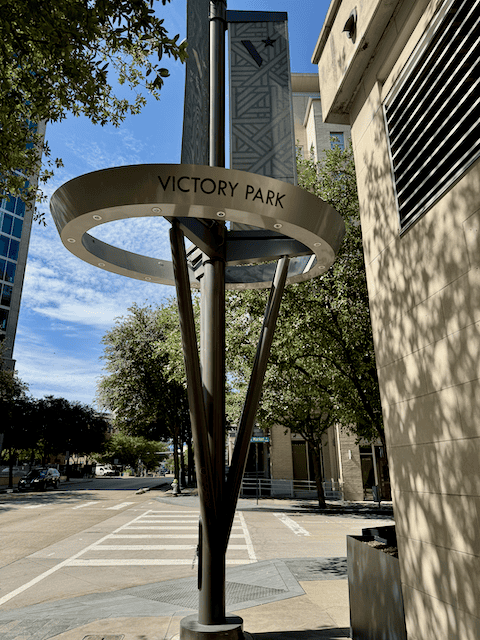
Every major city has a story of transformation — a moment where forgotten land is reborn into a destination. In Dallas, one of the clearest examples of that reinvention is Victory Park, the 75-acre neighborhood just northwest of downtown. Today it’s a polished mix of high-rise residences, offices, restaurants, and entertainment venues anchored by the American Airlines Center. But not long ago, this land was a relic of Dallas’s industrial past — a tangle of railroad tracks, a power plant, and grain elevators.
What makes Victory Park compelling isn’t just the change in land use, but the way it reflects the highs and lows of modern real estate development. It began as a bold vision spearheaded by Hillwood Development, Ross Perot Jr.’s company, to create an urban showpiece that could rival the lifestyle districts of other major U.S. cities. The early years were filled with marquee projects — the American Airlines Center, the W Hotel and Residences, the House of Blues — all built to announce that Dallas could do “urban cool” on a grand scale.
But the path wasn’t smooth. The district struggled with high-end retail and restaurant concepts that priced themselves beyond everyday appeal, making it more of a “special occasion” stop than a neighborhood. Add in the Great Recession and stalled projects like the Mandarin Oriental hotel tower, and Victory Park quickly became a case study in how even the most ambitious visions must bend to market realities.
 From Rail Yard to Arena
Before the cranes, glass towers, and luxury branding, the land that became Victory Park was an industrial rail yard. For decades, it served as backland for Dallas’s freight lines, dotted with silos and utility infrastructure. It was the kind of place people drove past on the highway without a second thought.
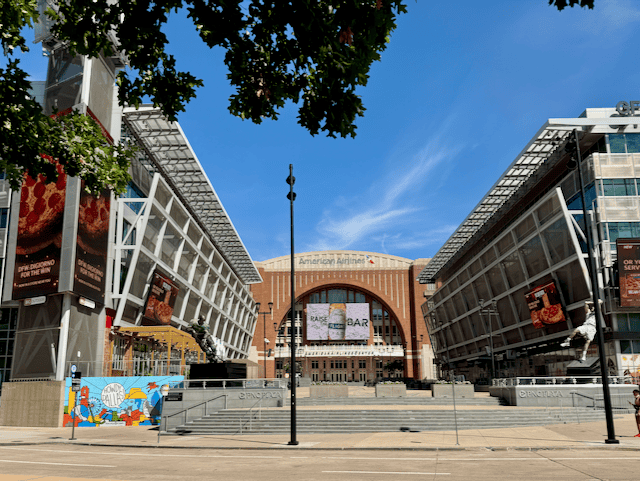
That changed in the 1990s when Dallas leaders began searching for a site to build a new arena for the Mavericks and the Stars. The old Reunion Arena had reached its limits, and a new venue was essential if Dallas wanted to compete with other major sports markets. Hillwood saw an opportunity. Instead of simply hosting the arena, they envisioned an entire district built around it: sports, entertainment, residences, hotels, retail, and offices all stitched together.
The American Airlines Center (AAC) became the anchor. Groundbreaking began in 1999, and by July 2001 the arena opened its doors. Overnight, what was once an anonymous rail yard became home to one of the busiest sports and entertainment venues in the nation. Every game, every concert, and every crowd spilling onto the streets put Victory Park on the city’s mental map. But Hillwood understood that an arena alone creates only bursts of activity. To make Victory Park a true neighborhood, they needed people living there, dining there, and returning when there wasn’t a game.
The First Wave: Flash and Ambition
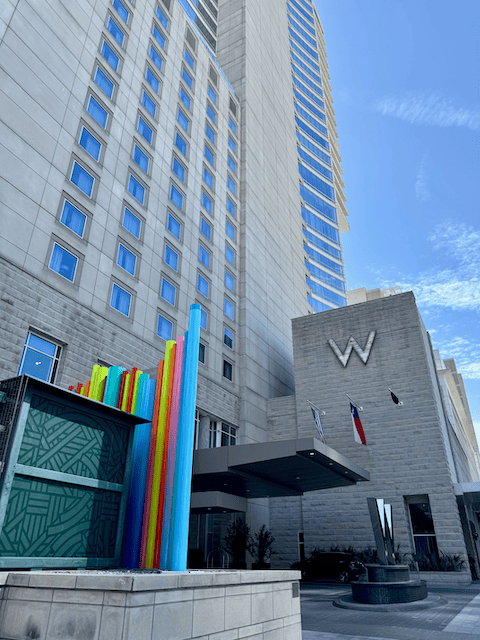
The first major step was the W Dallas Victory Hotel & Residences, which opened in 2006. At the time, the W brand was synonymous with luxury, nightlife, and design-forward living. Its arrival in Dallas sent a message: Victory Park was not going to be suburban or predictable — it would be sleek, international, and modern. The W combined hotel rooms with residences, complete with a rooftop infinity pool, a trendy lobby bar, and Ghostbar, one of the city’s most talked-about nightlife spots.
The project did so well that Hillwood doubled down, adding a second tower. In a clever move, the South Tower was built just tall enough to block the hotel-room views in the North Tower, but not high enough to obstruct the condo views perched above the hotel. The maneuver preserved premium resale values for residents while trading off some of the “wow factor” for hotel guests.
Victory Park also added cultural anchors. The House of Blues opened in 2007, bringing live music, dining, and nightlife into the mix. The One Victory Park office tower, anchored by Ernst & Young, opened in 2008, introducing the daytime population the district needed. On the residential side, The House, a Philippe Starck–designed condo tower, promised international flair but launched just as the financial crisis began to hit.
By the late 2000s, Victory Park had everything on paper: an arena, luxury residences, entertainment venues, and corporate offices. But beneath the glossy exterior, structural cracks were forming.
Overreach and the Downturn
Nothing captured Victory Park’s ambition more than the proposed Mandarin Oriental Hotel & Residences. The 43-story tower, designed by KPF, was slated to house a five-star hotel, luxury condos, and offices. It was meant to be the crown jewel, the project that announced Dallas as an international luxury market. Construction even began, but the 2008 financial crisis killed financing. The tower was canceled, leaving behind only a skeletal parking garage — a ghost of ambition.
Meanwhile, Victory Park’s condo market stumbled. The House struggled with sluggish sales, and the W Residences, though successful at launch, faced challenges in resales. Buyers who had put down deposits walked away as the economy soured.
Retail also faltered. Many of the restaurants and shops were high-priced and high-concept, better suited for splashy openings than day-to-day traffic. The district quickly gained a reputation as a place for special occasions — an anniversary dinner, a big night out before a concert — but not for everyday life. As a result, retail turnover was high, and storefronts sat empty.
The Great Recession magnified these weaknesses. The AAC still drew crowds, but those event surges weren’t enough to sustain the neighborhood. For several years, Victory Park risked becoming a cautionary tale: a bold, billion-dollar vision undone by bad timing and mismatched execution.
The Pivot: Apartments and Everyday Uses
By the early 2010s, developers realized that the original formula had to change. The answer was density. Instead of relying on expensive condos, Victory Park welcomed thousands of new apartments, catering to young professionals who wanted the location and the lifestyle without the commitment of ownership.
This shift transformed the neighborhood. Suddenly, sidewalks were busy in the mornings with dog walkers and coffee runs. Residents supported casual restaurants, bars, and services, giving Victory Park the daily rhythm it had lacked.
Along with housing, retail strategy shifted too. Out went the ultra-high-end boutiques and restaurants that had closed in waves. In came fast-casual dining, affordable bars, and neighborhood-oriented businesses. Victory Park stopped trying to be a destination for Dallas’s elite and started positioning itself as a place where locals actually wanted to spend time.
The real turning point was the opening of Cinépolis Luxury Cinemas in 2017. Unlike one-off concerts or games, a movie theater generates repeat traffic. Alongside House of Blues, it gave Victory Park reliable foot traffic on non-event nights and broadened the neighborhood’s appeal beyond sports fans and hotel guests.
For the first time, Victory Park began to feel like a neighborhood instead of an event zone.
Victory Park Today: A Mature Identity
By the late 2010s, the district had filled in its missing pieces. Apartment towers brought thousands of residents, retail finally matched demand, and the once-empty streets felt activated throughout the week. Connectivity improved as new sidewalks, crosswalks, and infrastructure linked the neighborhood more naturally to Uptown and Downtown.
Anchors remained steady: the AAC continued to rank among the busiest arenas in the country; the W Hotel transitioned from a hot new arrival into an established presence; and One Victory Park held strong with corporate tenants. Even earlier missteps, like The House, eventually stabilized.
And yet, traces of its early overreach still remain. The unfinished parking garage of the Mandarin Oriental project sits as a reminder of the perils of speculative luxury. But rather than dragging the neighborhood down, these remnants now feel like part of its history — proof that resilience matters more than perfection.
Victory Park may not have become Dallas’s Times Square, as some once imagined, but perhaps that’s for the best. Instead, it has matured into something more authentic: a neighborhood that balances entertainment with livability, ambition with pragmatism.
For me, Victory Park has always been a fascinating case study. In its early years, I thought of it as a “special occasion” destination — the place you’d splurge on dinner or visit before a big event. Today, it feels more grounded, more approachable, more like a true part of Dallas’s urban fabric.
And that may be its biggest victory. Not the glossy renderings or the bold announcements, but the fact that it learned to adapt, survived its setbacks, and emerged as a functioning, resilient neighborhood. In real estate, as in life, the projects that succeed aren’t always the ones that start perfectly, but the ones that evolve when the market tells them to.
For those looking to buy into Victory Park today, there are three condominium communities that anchor the residential market: The House, the W Dallas North & South Towers, and The Terrace. Each offers its own take on high-rise living, from contemporary design to hotel-branded luxury. And for those not ready to purchase, there’s also a strong mix of rental options throughout the neighborhood making it one of the most flexible urban districts in Dallas for both owners and renters.
:format(webp):quality(80)/u.realgeeks.media/mattwatson/agent_pic_sidebar.jpg "Agent Matt Watson")