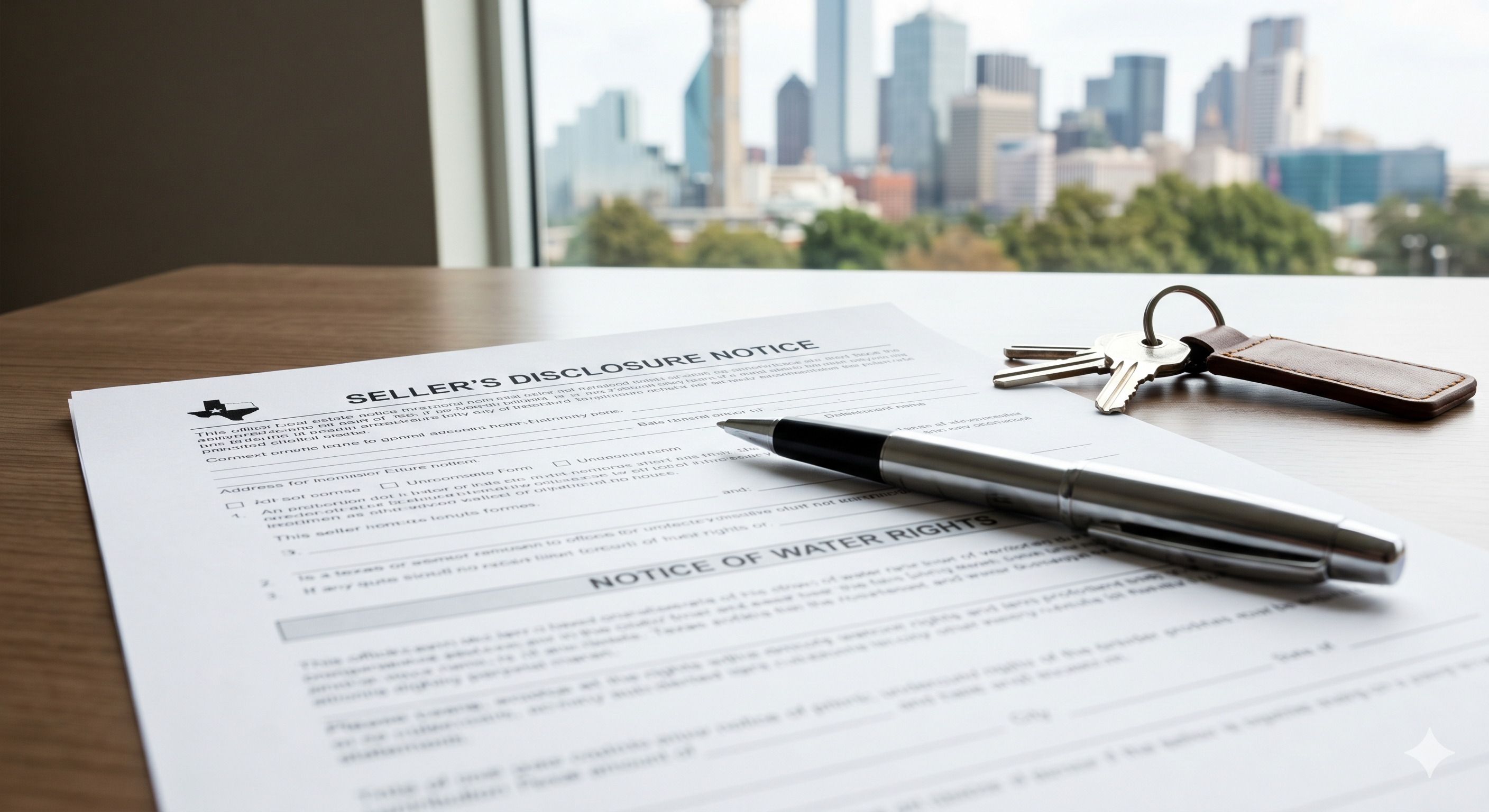
What must a seller disclose when selling a home in Texas?
Texas sellers are required by state law to provide buyers with a written Seller's Disclosure Notice covering the property's known defects, material conditions, and legal status before or during the contract period. The form is mandatory for most residential sales (1–4 units), and it covers everything from structural issues and water damage to HOA membership and environmental concerns. In 2026, TREC updated the form with six new disclosure categories — including insurance status and water rights — making it more comprehensive than any previous version.
By Matt Watson, Broker, REALTOR® | May 6, 2026
If you're thinking about selling your home in Dallas this year, one of the first things you'll complete before going under contract is the Texas Seller's Disclosure Notice. It's a TREC-required form, and it's not optional. Every seller of a residential property (one to four units) in Texas must provide it to the buyer.
Most sellers understand the concept — you disclose what you know about your home's condition. But the details matter, and the 2026 updates to the form have added six new categories that sellers haven't had to think about before. If you haven't listed yet, this is worth reading before you sign anything.
What the Texas Seller's Disclosure Notice Actually Covers
The form covers a wide range of property conditions and legal facts. You're disclosing what you know — you're not expected to be a home inspector, but you are expected to report issues you're aware of.
The core categories include:
Structural and mechanical systems — foundation status, roof condition, walls and ceilings, plumbing, electrical, HVAC, and built-in appliances. If you know your foundation was repaired three years ago, that goes on the form. If the HVAC is aging but working, you note it. If you've had roof leaks that were patched, you disclose them.
Water intrusion and drainage — any history of standing water in the yard, water penetration in the basement, or drainage problems on or near the property.
Hazardous materials — asbestos, lead paint, radon, mold, urea formaldehyde, or any underground storage tanks the seller is aware of.
Legal and ownership matters — whether the property is in a flood zone (including whether it has flooded in the past), whether it's subject to an HOA, whether there are any easements or encumbrances, whether it's in a special assessment district, and whether there are any pending legal proceedings or boundary disputes.
HOA specifics — if the property is in a homeowners association, you must disclose it and provide the governing documents. For condo and townhome owners in Uptown and Oak Lawn, this means disclosing the HOA's monthly dues, special assessments, and whether the association is involved in any litigation.
One thing that trips up sellers: the disclosure covers what you know, not what an inspector might find later. You're not required to hire an inspector before listing, but you are required to honestly answer every question on the form based on your personal knowledge.
What's New in 2026: The Six Updated Disclosure Categories
TREC proposed updates to Form 55-1 (the Seller's Disclosure Notice) in February 2026, with adoption effective May 28, 2026. If your listing agreement or contract is dated after that, your disclosure notice includes these new requirements.
1. Insurance status. You now must disclose whether the property is currently covered by homeowner's insurance, including windstorm coverage, and whether you've ever been unable to insure the property for any reason. This is a significant new addition. A history of insurance denials or cancellations signals potential risk to the buyer and their lender, and it now has to come out upfront.
2. Private road disclosure. If there is a private road on or adjoining the property that the buyer would be financially responsible for maintaining, that must be disclosed. This is more common in rural areas, but it also applies to gated communities and some shared-access situations in the urban core.
3. Above-ground storage tanks. If the property has an above-ground storage tank larger than 500 gallons that has stored petroleum products or other chemicals, it must now be disclosed. This is an item that simply wasn't on the form before.
4. Conservation easements. Sellers must now disclose whether the property is located within a conservation easement. These are recorded encumbrances that can restrict how the property is used or improved, and buyers need to know about them before they commit.
5. New Form 61-0 — Water Rights Notice. (July 1, 2026) This is an entirely new standalone form that TREC has created alongside the updated disclosure notice. It requires sellers to disclose what they know about groundwater and surface water rights on the property, including whether the property is located in a Groundwater Conservation District and whether there are water wells. For most sellers in the City of Dallas, this is straightforward — you're on municipal water and there are no wells. But if the property borders a creek, has an irrigation well, or is in an area with any surface water rights, the form applies and it's a separate document from the main disclosure notice.
6. General expansion of defect sections. Beyond the new categories above, TREC's update also expanded the detail and specificity required in several existing sections, particularly around structural and drainage disclosures.
If your agent gives you a disclosure form that doesn't include these categories, it may be an outdated version. Ask specifically whether they're using the current TREC forms.
The "As-Is" Clause Doesn't Exempt You From Disclosing
A lot of sellers in Dallas ask about listing "as-is." It's a reasonable strategy, especially in the current market where you're already dealing with buyer negotiations and don't want to be on the hook for every repair request that comes out of an inspection.
But here's what "as-is" does and doesn't do.
When you sell as-is, you're telling the buyer you won't make repairs and won't negotiate a price reduction based on inspection findings. That's valid, and buyers can accept those terms or walk during the option period. What you cannot do is use the as-is clause as a reason to skip the disclosure form or leave out known defects.
Texas courts have consistently held that the duty to disclose is separate from the as-is clause. If you know your foundation has a structural issue and you don't disclose it, you face potential legal liability regardless of whether the contract was written as-is. The disclosure notice and the as-is clause serve different purposes — one protects you from repair obligations, the other protects you from fraud claims.
If you're selling in as-is condition, you still complete the disclosure fully and honestly. The buyer's decision to proceed knowing the property's condition — and the legal record that you disclosed what you knew — is what protects you.
For context: in the current Dallas market, where buyers have more leverage than they've had in several years, a thorough and honest disclosure actually helps you. Buyers who find issues during inspection that weren't on the disclosure form are more likely to get frustrated and walk. Buyers who already know about issues from the disclosure, and who made an offer with that knowledge, are more likely to close.
When You Deliver the Disclosure and What Happens Next
Texas law requires you to provide the Seller's Disclosure Notice to the buyer before the contract is executed, or as a required exhibit to the contract. In practice, most Dallas listing agents include the disclosure as an addendum at the time of contract, and it's referenced directly in the TREC One to Four Family Residential Contract.
Once the buyer receives it, they have a right to terminate within a specific period if the disclosure reveals something they're not comfortable with. The TREC contract specifies this window, and it ties into the broader option period structure Dallas buyers use.
A few practical notes for Dallas sellers right now:
- Complete it before you list, not after you get an offer. Having your disclosure ready when buyers start touring your home prevents delays, reduces the risk of contract complications, and signals to serious buyers that you're organized and prepared.
- Don't guess on items you're unsure about. If you genuinely don't know whether something applies to your property, mark "unknown" rather than leaving it blank or checking "no." Unknown is honest. An incorrect "no" is not.
- Review your HOA documents before filling out the condo or townhome sections. If you own a condo in Uptown or a townhome in Oak Lawn, you'll need to disclose HOA financial health, any pending special assessments, and current monthly dues accurately. Buyers' lenders will verify this anyway, so the numbers need to match.
- Keep copies of everything. The signed disclosure is part of your transaction file. Your title company will want it, and your agent should maintain it as part of the transaction record.
The seller's disclosure is also just one piece of the paperwork puzzle when you're listing. For a full look at what you'll need to pull together before closing, see What Documents Do You Need When Selling a Home in Dallas?
And if you're weighing timing — whether to list now or wait — the property tax proration at closing is one financial detail worth understanding first: Do You Pay Property Taxes When Selling a Home in Dallas?
Frequently Asked Questions
Do I have to fill out a Seller's Disclosure Notice if I'm selling a condo in Dallas?
Yes. The Texas Seller's Disclosure Notice (TREC Form 55-1) is required for all residential properties with one to four units, including condos and townhomes. For condos, you'll also need to disclose HOA information, including monthly dues, any pending special assessments, and whether the association is involved in litigation. Your listing agent should walk you through the condo-specific sections before you complete the form.
What happens if I don't disclose a known defect in Texas?
Failure to disclose a known material defect can expose you to significant legal liability after closing, including fraud claims, rescission of the sale, and damages. Texas courts treat disclosure obligations seriously. The "as-is" clause in the contract does not protect you from liability for defects you knew about and chose not to disclose. If you're uncertain whether something needs to be disclosed, disclose it — the form protects you when it's completed honestly.
Can the buyer back out based on the Seller's Disclosure Notice?
Yes. Once the buyer receives the disclosure notice, they have a right to terminate within the period specified in the contract if the disclosure reveals something they're not willing to accept. In Texas, this generally ties into the option period structure, and the buyer's earnest money protections depend on the specific contract terms. If the disclosure reveals a material issue the buyer wasn't aware of, termination during the option period protects them.
Are the new 2026 TREC disclosure requirements already in effect?
The updated Form 55-1 and new Form 61-1 (Water Rights Notice) were proposed by TREC in February 2026, with the adoption in May 2026. If your listing agreement or purchase contract was executed on or after that date, you should be using the updated form. Ask your agent to confirm they're using the current version. If they hand you a form that doesn't reference insurance status or water rights, it may be out of date.
Do I have to disclose HOA special assessments when selling my condo?
Yes. If your condo association has voted on or is planning a special assessment, you must disclose it. Buyers — and their lenders — need to know about upcoming assessments because they affect the true cost of ownership. Sellers who fail to disclose known special assessments after closing often face disputes with buyers. Pull your HOA's recent meeting minutes and financial statements before you complete the disclosure so you can answer these questions accurately.
Completing the Seller's Disclosure Notice correctly is one of the most important things you'll do before your home goes on the market. It protects you legally, signals to buyers that you're dealing in good faith, and gives the transaction the clean foundation it needs to get to closing.
If you're preparing to sell in Dallas this year and want to walk through the disclosure requirements before you list, I'm happy to sit down with you and make sure you've covered everything — including the 2026 updates. Reach out at mattwatson.com and we'll set up a time to talk through your specific property.
About Matt Watson, Broker, REALTOR®
Matt Watson is a Dallas-based real estate broker and REALTOR® with over 25 years of experience in the city's urban core neighborhoods. He specializes in condos, townhomes, and single-family homes in Uptown, Oak Lawn, East Dallas, and North Oak Cliff. Whether you're buying your first condo or selling a longtime home, Matt brings deep local knowledge and straightforward guidance to every transaction. Connect with Matt at mattwatson.com.
