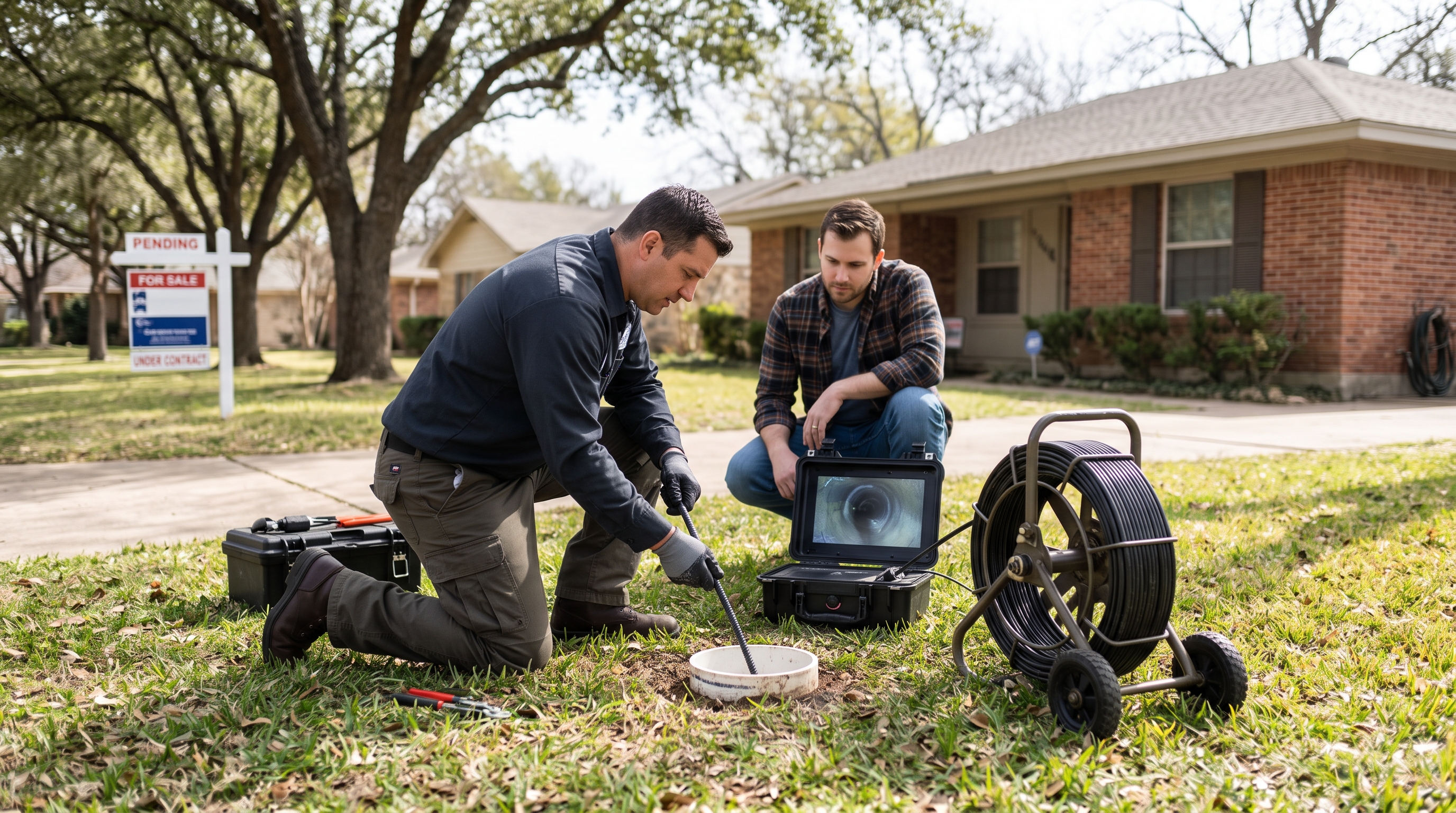
Is a sewer scope worth it when you buy a home in Dallas?
Yes, for most older Dallas houses it is. A sewer scope sends a camera through the line between the house and the city connection, and it usually costs a few hundred dollars. Standard home inspectors aren't required to inspect buried pipe, and repairs can run into five figures. If you're buying a house in East Dallas or North Oak Cliff, order the scope during your Texas option period, while you can still negotiate or walk away.
Here's a pattern I see more often than I'd like. A buyer gets a clean inspection report, closes, and six months later a plumber is quoting $12,000 to dig up the front yard. The report wasn't wrong. It just never covered the pipe that was failing.
That pipe is your sewer line, and it's the most expensive thing most buyers never think to check.
Why a standard inspection won't catch it
A licensed home inspector looks at what's visible and accessible. Fixtures, drains under sinks, and exposed plumbing all get checked. Buried pipe doesn't. The Texas Real Estate Commission's own guidance for inspectors says they aren't required to inspect anything buried, hidden, or concealed.
That leaves a gap between the toilet and the street. Inside that gap, you could have:
- Cast iron drain lines that corrode from the inside out, which is common in houses from the 1920s through the 1950s
- Clay or older pipe with joints that have shifted and let roots in
- Offsets and low spots where the pipe has settled, so waste sits instead of flowing
- A cheap PVC patch at the cleanout that hides older pipe underneath
Dallas makes this more likely than in some other cities. Our expansive clay soil swells and shrinks with the weather, and that movement can pull pipe joints apart. Mature trees in the older neighborhoods add roots to the mix.
If you've read my post on what to look for in a Dallas home inspection, think of the sewer scope as the add-on that covers the one system the standard visit can't reach.
What a sewer scope costs, and what a failure costs
A scope is a licensed plumber or specialty inspector feeding a waterproof camera through the cleanout. You get video and a written report. Pricing varies with line length and access, and national averages sit near $1,000 with a wide range. Many buyers in this market pay a few hundred dollars, so get a quote before you book.
Now compare that to repair costs. Published Dallas figures put conventional dig-and-replace work at roughly $50 to $250 per linear foot, which means a 100-foot line can land anywhere from $5,000 to $25,000 before permits, landscaping, and any concrete that has to come up. Trenchless methods can reduce the mess but often cost more per foot, and Dallas soil can make that work harder.
Those aren't predictions about your house. They're the range of what a failed line costs to fix today. With 30-year mortgage rates averaging around 7.4% in Freddie Mac's survey for the week of October 15, most buyers don't have much room in the budget for a surprise like that.
When you should order one
You don't need a scope on every purchase. You should strongly consider one when:
- The house is more than 25 or 30 years old. In East Dallas and North Oak Cliff, that describes a lot of what's for sale.
- There are large trees near the house or the front yard. Roots find joints.
- The seller mentions slow drains, past backups, or "updated plumbing." Ask what was updated. Often it's the kitchen and bath, not the pipe under the yard.
- The inspector noted foundation movement. Movement can break pipe. If foundation history is part of your decision, my guide to buying a house with foundation repair history covers what to ask.
- The cleanout cap looks corroded or newer than the rest of the line.
For newer construction, a scope is less urgent, though some buyers still order one for peace of mind.
What about condos and townhomes?
This is where Uptown and Oak Lawn buyers can usually relax a little, but not completely. In a high-rise or mid-rise condo, the main stacks and building sewer lines are normally a common element, which means the HOA is responsible and you pay through dues or, in a bad year, a special assessment. That's why the resale certificate and the HOA's reserve information matter more than a camera.
Townhomes are different. Depending on how the community is platted and what the declaration says, you may own and maintain the line from your unit to a shared main, or you may share responsibility for part of it. Read the declaration, then ask the HOA directly. If you'd own any piece of the line, a scope may still make sense.
How to use the results during your option period
Timing is everything in a Texas contract. Your option period is the window where you can terminate for any reason, and it's also the easiest time to negotiate repairs. Option periods commonly run about 5 to 15 days, so book the scope early, ideally the same day as your inspection.
If the camera finds a problem, you generally have four paths:
- Ask the seller to repair it through a TREC amendment, using a licensed plumber and getting the report in writing
- Ask for a credit or price reduction so you can handle the repair after closing
- Get a second opinion or a repair quote before you decide how hard to push
- Terminate during the option period if the cost or the risk is more than you want to take on
Keep in mind that the seller isn't obligated to agree to any of them. The scope gives you facts and leverage, not a guarantee. What it does guarantee is that you decide before your option period ends, not after you close.
One more note on insurance. Most standard homeowners policies cover sudden and accidental damage, and wear-related pipe failure typically isn't treated the same way. Sewage backup into the house is usually a separate endorsement, often offered in limits like $5,000, $10,000, or $25,000. Ask your agent about it, and read my overview of homeowner's insurance in Dallas before you finalize a policy.
A quick word on timing at the state level: TREC's inspector committee has been working on formal standards for how inspectors handle sewer scope work. Ask whoever you hire what they will inspect and report, and request the video, not just a summary.
Frequently Asked Questions
How much does a sewer scope cost in Dallas?
Many buyers pay a few hundred dollars, though price depends on line length, access, and who performs it. National averages run closer to $1,000, so get two quotes. Compare that to the $5,000 to $25,000 range often quoted for replacing a typical sewer line.
Does a standard Texas home inspection include the sewer line?
Usually not. Texas inspectors report on visible and accessible plumbing and aren't required to inspect buried or concealed pipe. A sewer scope is a separate service you request, often from a plumber or a specialty inspector.
Can I ask the seller to fix a bad sewer line?
You can ask, and the best time is during your option period through a TREC amendment. The seller can agree, offer a credit, counter, or say no. If they say no, you still have your option period right to terminate.
Do I need a sewer scope for a Dallas condo?
Often not for the main building lines, because those are usually the HOA's responsibility. Check your declaration and resale certificate to see where your responsibility starts. Townhome buyers should confirm what they own before skipping the scope.
Does homeowners insurance cover sewer line repair?
Policies vary, so ask your agent for the exact wording. Wear-related pipe failure generally isn't covered like a sudden event, and sewage backup into the home is usually offered as an add-on endorsement.
Next steps
A sewer scope is a small cost that can protect you from a very large one, and it's most valuable on the older East Dallas and North Oak Cliff houses many of my clients love. If you're writing an offer, we can build the scope into your inspection plan so it happens inside your option period.
If you want help figuring out what to inspect, what to ask for, and what a house is really worth in today's Dallas market, I'd be happy to talk it through. No pressure, no obligation, just real numbers and straight answers from someone who knows these neighborhoods. Reach out at mattwatson.com and we'll walk through it together.
About Matt Watson, Broker, REALTOR®
Matt Watson is a Dallas-based real estate broker and REALTOR® with over 25 years of experience in the city's urban core neighborhoods. He specializes in condos, townhomes, and single-family homes in Uptown, Oak Lawn, East Dallas, and North Oak Cliff. Whether you're buying your first condo or selling a longtime home, Matt brings deep local knowledge and straightforward guidance to every transaction. Connect with Matt at mattwatson.com.
This article is general information, not legal, financial, or engineering advice. Costs and market figures reflect current conditions and will vary by property.