


 Is It Cheaper to Move to Dallas From California or New York in 2026?
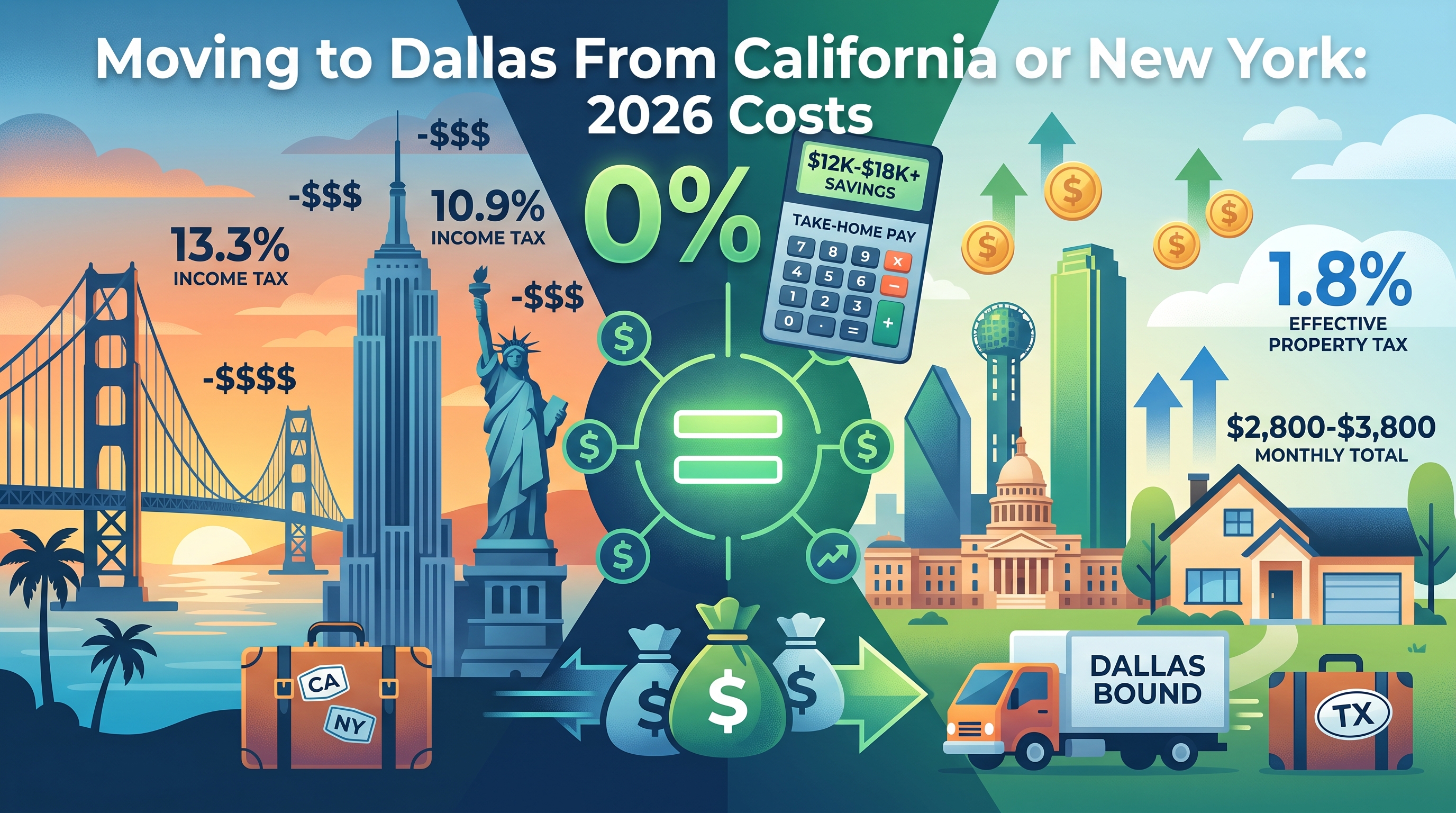
For most households relocating from California or New York, moving to Dallas in 2026 delivers clear net financial savings—though the gap is structured differently than a few years ago. Housing in Dallas costs roughly 40% to 55% less than in coastal California or NYC, and Texas charges no state income tax. For a household earning $200,000 a year, zero state income tax translates to $12,000 to $18,000 in annual take-home savings, depending on whether you are moving from California or New York City.
However, Dallas property taxes run a gross combined rate of 2.0% to 2.5% of assessed value, among the higher rates in the country. While the Texas Homestead Exemption helps soften this blow for primary residences (bringing effective tax rates down closer to 1.6%–1.8%), property taxes and homeowners insurance still eat into savings faster than many coast-to-coast movers anticipate.
By Matt Watson, Broker, REALTOR®
I get a version of this question almost every week from clients relocating to Dallas, and it usually comes with healthy skepticism. Buyers have heard Texas is cheaper, but they’ve also heard property tax horror stories, and they want exact numbers before they start packing boxes.
Here is what the real math looks like right now.
The Real Cost Comparison: Housing, Taxes, and Take-Home Pay
Start with housing, as it represents the single largest line item and the biggest financial relief for relocating buyers.
-
Single-Family Suburbs: A three-bedroom home running close to $900,000 in a Los Angeles or Bay Area suburb typically costs $350,000 to $500,000 in a comparable Dallas-area suburb.
-
Urban Core: Home prices across Dallas’s urban core—including Uptown, Oak Lawn, East Dallas, and North Oak Cliff—generally fall between $250,000 and $1.2 million+. Condos and townhomes anchor the entry level, while renovated historic single-family homes sit at the higher end. Median urban core prices hover around $490,000.
-
State Income Tax Savings:
-
From California: For a joint household earning $200,000, California’s effective state tax rate sits around 6%–7% (the top marginal 9.3%+ rates hit higher brackets). Moving to Texas saves roughly $12,000 to $14,000 per year in state income tax.
-
From NYC: A single filer or joint household leaving NYC saves both New York State and NYC local income taxes, yielding $16,000 to $18,000+ per year in take-home savings at the $200,000 income level.
-
-
Monthly Ownership Costs: For a Dallas urban core property in the $400,000–$500,000 range, total monthly ownership payments (including principal, interest, taxes, home insurance, and HOA dues) typically land between $2,800 and $3,800/month, depending on your down payment and loan structure.
Where the Savings Shrink (and Where They Don't)
This is the section most relocation guides gloss over, but it’s what actually dictates your monthly cash flow once you close.
1. Property Taxes & Insurance (The Escrow Reality)
Texas property taxes fund local services, schools, and infrastructure in the absence of a state income tax. The gross combined tax rate across Dallas ISD, the City of Dallas, and Dallas County averages ~2.22%.
-
The Gross Math: On a $500,000 assessed home, gross taxes equal roughly $11,100 per year.
-
The Homestead Exemption Cushion: Once you file for the Texas Homestead Exemption on your primary residence (which exempts $100,000+ of assessed value from school district taxes), your effective property tax rate drops closer to 1.6%–1.8% ($8,000–$9,000/year).
-
Homeowners Insurance: DFW weather brings hail and severe spring storms. Budget $2,500 to $4,000/year for homeowners insurance—substantially higher than coastal CA, though comparable to high-risk NY areas.
2. Transportation & Auto Dependency
If you are relocating from New York City or dense parts of San Francisco, moving to Dallas almost always requires adding or upgrading a vehicle.
-
Auto Expenses: Budget for a car payment, auto insurance (Texas insurance rates run ~15% higher than national averages due to severe weather risks), gas, and NTTA toll fees (Dallas’s major arteries like the Dallas North Tollway and Sam Rayburn Tollway are toll roads).
-
The Bottom Line: Even with $300–$500/month in added vehicle expenses, the net savings from lower housing costs and zero state income tax keep most coastal transplants well ahead financially.
Choosing a Dallas Neighborhood
Where you settle in Dallas depends on how you balance walkability against lot size and housing style.
-
For Walkability & High-Density Living: Uptown and Oak Lawn offer the closest match to coastal urban hubs. Both features high-density condos, townhomes, and walkable access to the Katy Trail, McKinney Avenue, and Klyde Warren Park.
-
For Character & Space: East Dallas (including Lakewood and M Streets) and North Oak Cliff (including Bishop Arts) offer character-rich single-family homes, mature trees, and lot sizes rarely available at approachable price points in coastal markets.
-
Market Dynamics: Dallas is currently navigating a buyer's market, with inventory levels across the DFW region holding at multi-year highs (over 5 months of supply). For relocating buyers, this provides real leverage to negotiate seller concessions, closing cost credits, or rate buydowns.
Frequently Asked Questions
Is Dallas actually cheaper than Los Angeles or New York? Yes. Even after factoring in property taxes, insurance, and vehicle ownership, the combined impact of 40%–50% lower real estate purchase prices and zero state income tax creates a net positive financial outcome for the vast majority of households.
How does the Texas Homestead Exemption work for new buyers? When you purchase a home as your primary residence in Texas, you qualify to file for a Homestead Exemption. This removes a portion of your home's value from taxation for school district purposes and caps annual assessment increases at 10% in subsequent years.
Do I need a car if I move to Dallas's urban core? While neighborhoods like Uptown and Bishop Arts are walkable for dining and daily errands, DFW as a region is inherently car-dependent. Most residents in the urban core maintain at least one vehicle for commuting, grocery trips, and regional travel.
How long does it take to close on a home in Dallas? Standard contract-to-close timelines in Texas run 30 to 45 days. This timeframe accounts for the option period (inspection phase), appraisal, title search, and final mortgage underwriting.
:format(webp):quality(80)/u.realgeeks.media/mattwatson/agent_pic_sidebar.jpg "Agent Matt Watson")