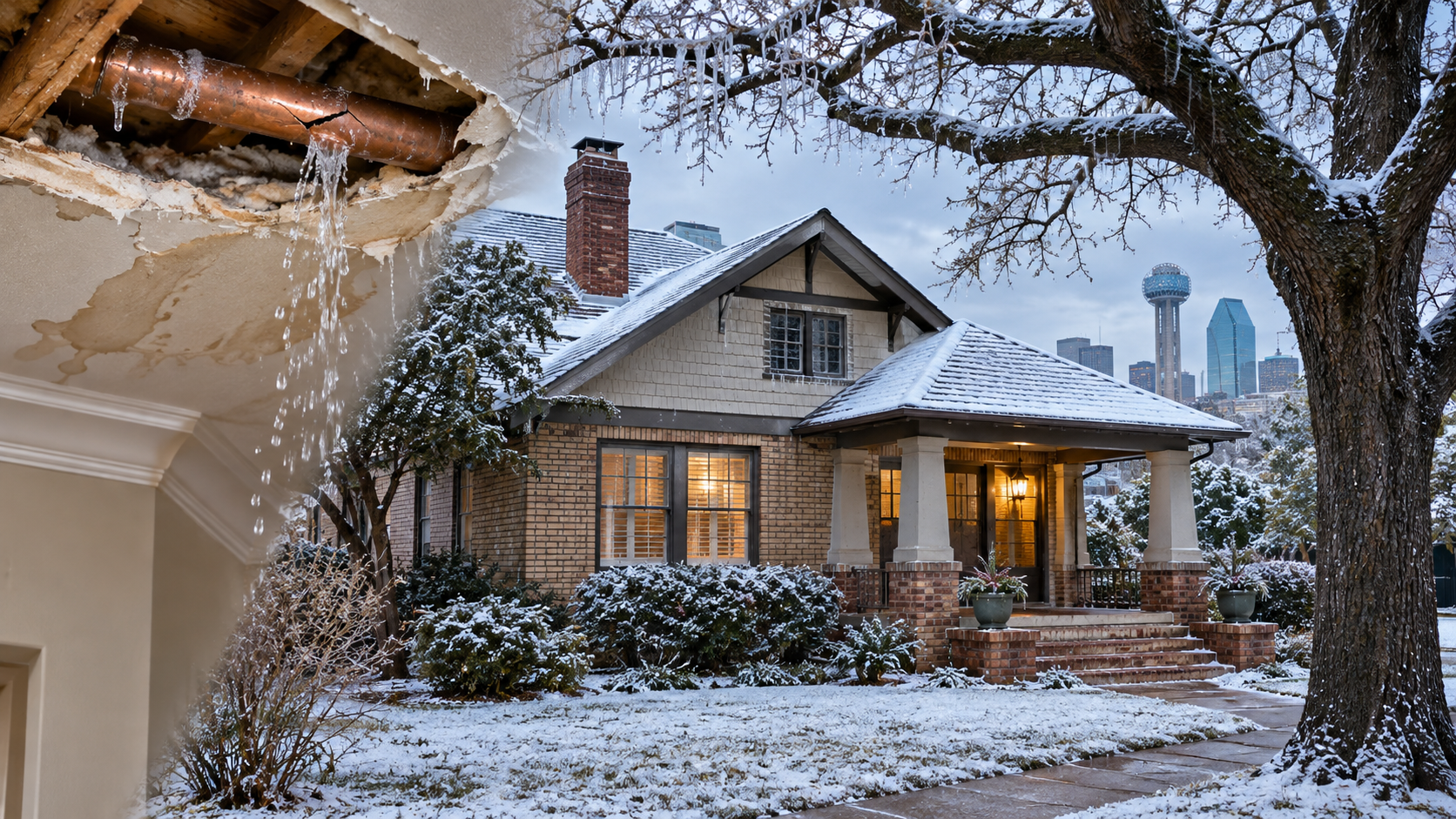
What happens if pipes freeze or burst while a Dallas home is under contract?
Under the standard Texas resale contract (TREC Paragraph 14, Casualty Loss), the seller has to restore the home to its previous condition by the closing date. If the seller can't, you as the buyer can terminate and get your earnest money back, extend closing up to 15 days, or close on the damaged home with the seller's insurance proceeds and a credit for the deductible. Sellers with a vacant listing should keep the heat on, protect exposed pipes, and check the vacancy terms in their homeowners policy before the first hard freeze.
By Matt Watson, Broker, REALTOR® | November 13, 2026
A Dallas freeze doesn't have to be a February 2021 event to wreck a closing. One cold night, one attic pipe, and one vacant house is all it takes.
And this is the season when it happens. Homes are sitting on the market longer right now (Redfin counted price cuts on 26.6% of Dallas listings in the four weeks ending September 20, one of the highest shares in the country), which means more listings, many of them vacant, will sit through the cold months. If you're selling a house you've already moved out of, or you're a buyer with a closing date in December or January, you need a plan before the forecast drops below freezing.
Here's how the contract handles it, what each side can do, and the steps that keep a frozen pipe from becoming a dead deal.
What the Texas contract says when a freeze damages the home
The TREC One to Four Family Residential Contract (Resale) has a paragraph written for exactly this: Paragraph 14, Casualty Loss. A burst pipe, water damage, or a collapsed ceiling after the contract's effective date counts as a casualty.
Here's how it works:
- The seller restores the property. The seller is required to put the home back in its previous condition as soon as reasonably possible, and in any event by the closing date.
- If the seller can't finish in time because of factors outside their control, the buyer chooses one of three paths: 1. Terminate the contract and get the earnest money refunded (the option fee isn't refunded). 2. Extend the time for performance up to 15 days, with closing pushed back as needed. 3. Accept the home as is at closing, along with an assignment of the seller's insurance proceeds (if the seller's carrier allows it) and a credit from the seller for the insurance deductible.
Notice who carries the risk. Until closing, the house is the seller's responsibility. That's why "who pays for the burst pipe?" almost always has the same answer in a Texas resale: the seller does, either through repairs, insurance, or a renegotiated deal.
If you're still in the option period
Buyers, this is your simplest exit. During the Texas option period, you can terminate for any reason and get your earnest money back. If a freeze hits during those days and you find water damage, you can walk, renegotiate the price, or ask for repairs or a credit. You aren't limited to the Paragraph 14 options.
After the option period ends, Paragraph 14 is what protects you.
If you're the buyer: what to do after a hard freeze
Most of the damage from a freeze doesn't show up while it's cold. Pipes split while frozen and leak when they thaw. That's why the days after a freeze matter more than the freeze itself.
Ask for access as soon as temperatures rise. Have your agent request a quick visit to run every faucet, flush every toilet, and look at ceilings, under sinks, and along exterior walls. Check the water heater and the area around the washer connections.
Get the right people in. If anything looks off, a licensed plumber can pressure-test the lines. For a pier and beam house in East Dallas or North Oak Cliff, pipes in the crawl space are more exposed, so ask for a look underneath, not just inside. On slab homes, watch for warm or damp spots in the floor and the sound of running water when every fixture is off.
Call your lender and your insurance agent. After a widespread freeze, lenders sometimes want proof the home wasn't damaged before they fund, and some ask for a re-inspection or updated appraisal. Your homeowners insurance quote before closing may also need an update if the seller files a claim, since a fresh water claim can show up in the home's claim history.
Put every change in writing. If you agree to an extension, a price reduction, or a repair credit, use a written amendment signed by both sides. A text or phone call won't protect you. If closing has to move, here's what happens when a Texas closing gets delayed, including rate lock extension costs.
Do your final walk-through after the last freeze, not before. If a cold snap lands between your walk-through and your closing, ask for a second one. I cover the full checklist in my guide to the final walk-through in Texas.
Condo buyers in Uptown and Oak Lawn
High-rise and mid-rise condos are less exposed to frozen pipes than detached houses, but they're not immune. Fire sprinkler lines in garages and stairwells, pipes in exterior walls, and units above yours can all fail in a hard freeze. One burst line on an upper floor can send water down through several units.
If you're under contract on a condo and a freeze hits, ask the HOA or management company two questions: did the building have any water events, and is the unit you're buying affected? The answers matter for who pays. The HOA's master policy and the declaration decide where the association's responsibility ends and the owner's HO-6 policy begins. If the unit has had water damage before, my guide to buying a Dallas condo with a past water leak walks through the documents to request.
If you're the seller: how to protect a vacant listing this winter
If you've already moved out, your house is at higher risk than an occupied one. Nobody notices a slow drip, nobody hears the attic pipe, and a thermostat bumped down during a showing can stay there for days.
There's also an insurance issue that catches sellers off guard. Many homeowners policies limit coverage once a home has been vacant for a set period, commonly 30 or 60 days, and many policies exclude freeze damage when the owner didn't keep the heat on or shut off and drain the water. The Texas Supreme Court upheld a 60-day vacancy clause in Greene v. Farmers Insurance Exchange (2014), even though the vacancy didn't cause the loss. Policy language varies by carrier, so read yours or call your agent before you assume you're covered.
Here's the winter checklist I give sellers with a vacant Dallas listing:
- Call your insurance agent first. Ask how long the home can sit empty before coverage changes, and whether you need a vacancy endorsement or a vacant dwelling policy.
- Keep the utilities on and the heat running. A setting in the mid-50s or higher is a common recommendation. A smart thermostat lets you confirm the temperature from your phone.
- Protect what's exposed. Disconnect garden hoses, cover outdoor faucets, insulate attic and exterior-wall pipes, and drain irrigation lines.
- Prepare for a hard freeze night. Open sink cabinets on exterior walls and let faucets drip. If you can't get there, ask your agent or a neighbor to check.
- Know where your shut-off valve is. If you decide to shut off and drain the water, talk to a plumber first, especially if the home has a fire sprinkler system.
- Tell showing agents. Add a note to the showing instructions asking agents to leave the thermostat as set and confirm faucets are off before they leave.
- Keep a record. Dated photos and a simple log of each visit help if you ever file a claim.
If the damage already happened
Don't panic, and don't hide it. Call your insurance company, stop the water, document everything, and start drying the home out quickly to limit mold.
Then talk with your agent about disclosure. Water damage and repairs are now things you know about, so your Texas Seller's Disclosure Notice likely needs to be updated before the next buyer relies on it. If you're already under contract, your buyer has the Paragraph 14 options above, and your best move is usually to show them a clear repair plan with a licensed contractor and a realistic timeline.
A burst pipe doesn't automatically kill a sale. In my experience, deals survive when the seller is upfront, the repairs are documented, and both sides agree in writing on what happens next. Deals fall apart when the buyer finds the damage on their own.
How the numbers usually play out
Every situation is different, but here's how a typical case might look. Say a seller in North Oak Cliff has a vacant $425,000 house under contract, and a pipe in an exterior wall bursts during a January freeze. The plumber and drywall work comes to $9,000, and the seller's policy has a $4,250 deductible (1% of dwelling coverage).
- If the seller repairs it in time, the deal closes as planned, and the buyer re-checks everything on the walk-through.
- If repairs need more time, the buyer can agree to extend up to 15 days.
- If the buyer would rather handle it, they can close with the insurance proceeds assigned and a $4,250 deductible credit, assuming the seller's carrier and the buyer's lender both approve.
- If the buyer is nervous, they can terminate and get the earnest money back.
That's why the conversation in the first 48 hours matters. The seller who picks up the phone, files the claim, and gets a written repair estimate is the seller who keeps the buyer.
Frequently Asked Questions
Who pays if pipes burst before closing in Texas?
Under the standard TREC resale contract, the seller is responsible for damage that happens after the contract's effective date and before closing. The seller must restore the property by closing, or the buyer can terminate and get the earnest money back, extend up to 15 days, or close with an assignment of insurance proceeds and a deductible credit.
Can a buyer back out if a freeze damages the house?
Yes. During the option period, a buyer can terminate for any reason. After the option period, if the seller can't restore the home by closing because of factors beyond the seller's control, Paragraph 14 lets the buyer terminate and get the earnest money refunded.
Does homeowners insurance cover frozen pipes on a vacant house in Texas?
It depends on the policy. Many policies cover sudden and accidental pipe bursts, but they can limit coverage after a home has been vacant for a set period, often 30 or 60 days, or exclude freeze damage if the heat wasn't maintained. Sellers with a vacant listing should confirm their policy's vacancy terms before winter.
Should I winterize my vacant house while it's listed in Dallas?
Yes. Keep the heat on, cover outdoor faucets, insulate exposed pipes, and make sure showing agents leave the thermostat alone. Talk to a plumber before shutting off and draining the water so you don't disable a fire sprinkler system or create problems for showings and inspections.
Do I have to disclose a burst pipe that was repaired?
In Texas, the Seller's Disclosure Notice asks about known conditions, including previous water damage and repairs. If a pipe burst and was repaired, plan to disclose it along with the repair documentation, and talk with your agent about updating the notice before a buyer relies on it.
The bottom line
A freeze is the seller's risk until closing, and the Texas contract gives buyers clear options if damage shows up. Sellers protect themselves by keeping a vacant home heated, checking their insurance, and acting fast if something breaks. Buyers protect themselves by inspecting after the thaw and putting every change in writing.
If you're selling a vacant home this winter, or you're under contract and worried about what the next cold front will do, I'm happy to walk you through your options. That includes a free, no-obligation home valuation or buyer consultation with real numbers from someone who's worked Dallas's urban core for more than 25 years. Reach out at mattwatson.com and we'll talk it through.
About Matt Watson, Broker, REALTOR®
Matt Watson is a Dallas-based real estate broker and REALTOR® with over 25 years of experience in the city's urban core neighborhoods. He specializes in condos, townhomes, and single-family homes in Uptown, Oak Lawn, East Dallas, and North Oak Cliff. Whether you're buying your first condo or selling a longtime home, Matt brings deep local knowledge and straightforward guidance to every transaction. Connect with Matt at mattwatson.com.