


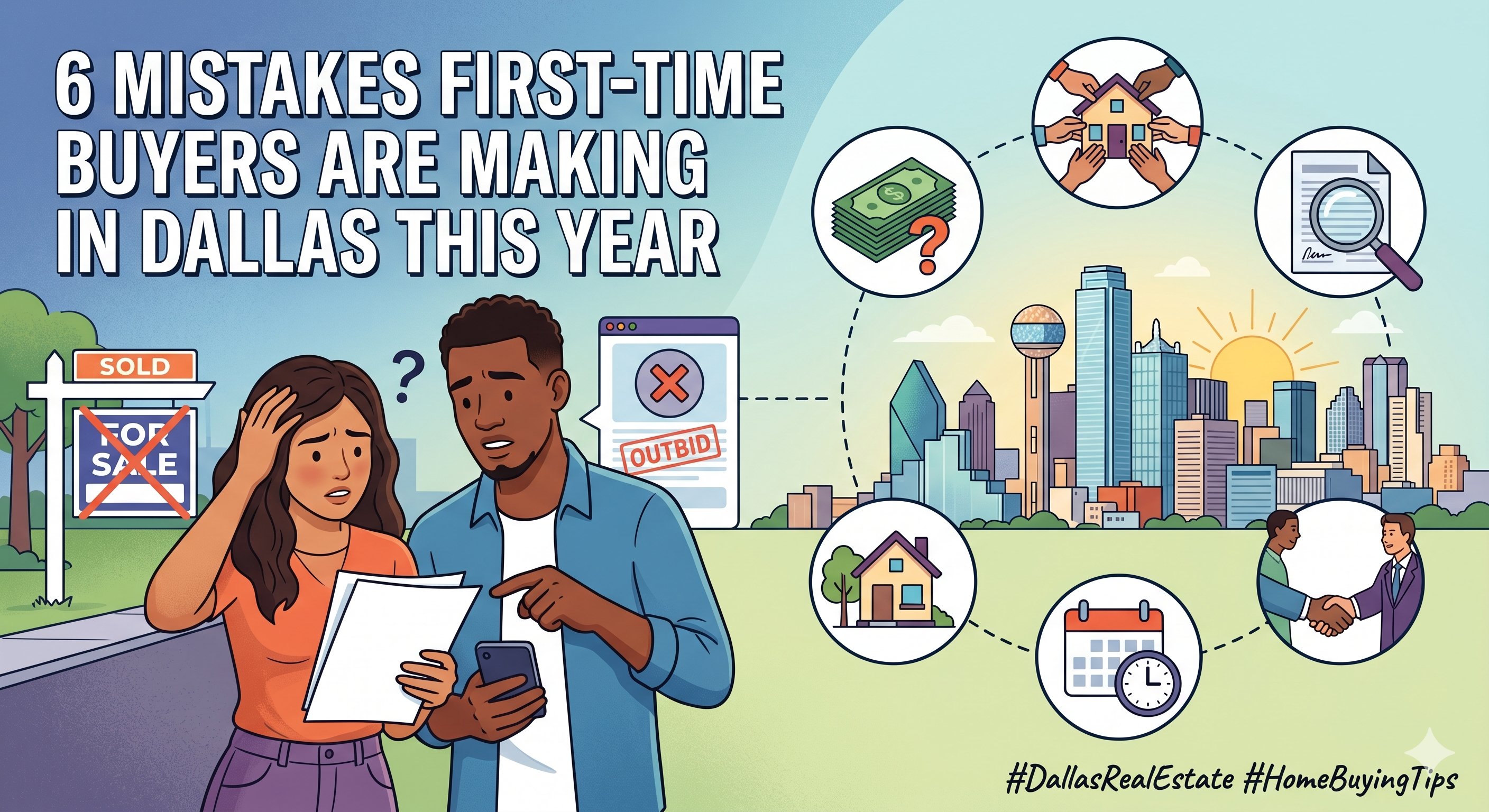
6 Mistakes First-Time Buyers Are Making in Dallas This Year
What are the most common first-time buyer mistakes in Dallas in 2026? Dallas first-time buyers are most often tripped up by underestimating the true monthly payment, trusting online estimates over a real lender's numbers, and shopping without a neighborhood-level strategy.
I've been working with buyers in Dallas since 2000, and the mistakes I see first-time buyers make today are different from what I saw five or ten years ago. The market has shifted. The cost structure has shifted. And a lot of the tools buyers rely on, like the big home search portals, have not kept up.
If you're buying your first home in Dallas this year, the list price is almost the least important number you'll look at. What matters is the full monthly payment, the actual condition of the market in the specific neighborhood you're targeting, and whether your financing is buttoned up before you ever tour a home.
Here are six mistakes I see first-time buyers make in Dallas right now, and how to avoid each one.
Mistake 1: Starting the Search Before Knowing the Real Monthly Payment
This is the one that stings the most because buyers don't realize it until they're already emotionally attached to a home they can't actually afford.
A $350,000 home in Dallas does not have a $350,000 payment. When you layer in property taxes, homeowners insurance, HOA dues (which are common in Uptown, Oak Lawn, and many East Dallas townhome communities), and PMI if your down payment is under 20%, the monthly number can be $500 to $1,000 higher than what a basic mortgage calculator shows.
How to avoid it: Before you tour a single home, sit down with a lender and get a full payment breakdown at a few different price points. Know your ceiling before you fall in love. One advantage of working with someone who handles both sides of the transaction is that the financing conversation and the home search happen together, so your budget is always grounded in real numbers.
Mistake 2: Trusting Zillow-Style Estimates Instead of a Lender's Full Breakdown
Online home search tools are built for browsing. They are not built for budgeting. The payment estimates you see on Zillow and similar platforms typically use outdated tax rates, exclude HOA dues, and assume insurance costs that may not reflect Dallas pricing.
Texas property taxes are among the highest in the country. Depending on the city, county, and any applicable municipal utility district (MUD) overlays, your effective tax rate on a Dallas home can run between 1.8% and 2.4% of the assessed value per year. That alone can add $500 or more to your monthly payment on a $350,000 home compared to what an online estimate shows.
How to avoid it: Ask your lender to run a full payment estimate that includes taxes pulled from the actual county appraisal district data for the specific property you're considering. Do not use the payment calculator on the listing portal as your guide. When your agent and your lender are on the same page, or the same person, this kind of cross-check happens automatically.
Mistake 3: Ignoring Dallas Property Taxes and Insurance
Even buyers who know Texas taxes are high tend to underestimate what that means month to month. And in 2026, homeowners insurance has become a real line item in ways it wasn't five years ago. Carriers have pulled back from certain markets, premiums have increased, and some properties, particularly older homes in East Dallas and North Oak Cliff, may require additional coverage depending on the condition of the roof or other factors.
If you buy a $400,000 home in Dallas with a 2.1% effective tax rate, that's $8,400 per year in property taxes, or $700 per month, before you've paid a dollar toward principal or interest.
How to avoid it: Get an actual insurance quote on any home you're serious about before you make an offer. And rather than relying on the seller's current tax bill, ask your lender or agent to estimate taxes based on the purchase price. The county will reassess the home after it sells, so what the seller is paying today may be significantly lower than what you'll owe in year one or two. Having someone who can model that number from both the real estate and mortgage side of the table makes a real difference here.
Mistake 4: Shopping Without Pre-Approval or With Weak Financing Preparation
In neighborhoods like Uptown and Oak Lawn, where well-priced condos and townhomes move quickly, showing up without a pre-approval letter puts you at an immediate disadvantage. A seller isn't going to accept an offer from an unknown buyer when a pre-approved buyer is standing right behind you.
Pre-qualification is not the same as pre-approval. Pre-qualification is a five-minute conversation. Pre-approval involves verifying your income, assets, and credit. In a market where sellers are still selective, you need the real thing.
Beyond the letter itself, weak financing preparation can mean credit issues that surface mid-transaction, debt-to-income ratios that limit your purchasing power, or an insufficient down payment that leaves you scrambling.
How to avoid it: Get fully pre-approved before you start touring homes. Know your loan type, your rate range, and your maximum payment. And keep that pre-approval current, they typically expire after 60 to 90 days.
Mistake 5: Making Big Financial Moves During Escrow
This one can kill a deal at the closing table. Once your offer is accepted and you're under contract, your financial profile is essentially frozen. Lenders re-verify your credit, income, and debt load before funding the loan. Any significant change can trigger delays or a denial.
Buyers open new credit cards. They finance furniture. They buy a new car because they're excited about the new house and figure they'll sort it out later. These decisions can change your debt-to-income ratio enough to affect your loan approval, even after you've been pre-approved and are three weeks from closing.
How to avoid it: From the moment you go under contract until the moment you close, do not open new credit accounts, do not make large purchases on credit, and do not make large deposits into your bank accounts without being able to document the source. Talk to your lender before doing anything financially significant during the transaction. If your lender is also your agent, that line of communication is a lot shorter, which can prevent a lot of last-minute surprises.
Mistake 6: Misreading the Neighborhood Market
Dallas is not one market. Uptown is different from Oak Lawn. Oak Lawn is different from East Dallas. East Dallas is different from North Oak Cliff. And within each of those areas, individual streets and building types behave differently.
First-time buyers often rely on broad market headlines, like "Dallas is a buyer's market" or "inventory is up," and then get surprised when the specific home they want in the specific neighborhood they're targeting receives multiple offers and closes over list price.
Pricing strategy, days on market, list-to-sale price ratios, and offer competition all vary at the neighborhood level. If you're buying a condo in Uptown, you need to know what that building's recent sales look like, not what the Dallas metro median tells you.
How to avoid it: Work with an agent who tracks neighborhood-level data, not just citywide trends. Before making an offer, review comparable sales from the last 60 to 90 days in that specific area. Understand whether you're in a position to negotiate or whether you need to come in sharp.
The Bottom Line
Buying your first home in Dallas is a real goal, and it's absolutely achievable. But the buyers who get into trouble are almost always the ones who started the process with the wrong information: an inflated budget based on online estimates, no pre-approval, or a broad market assumption that didn't hold up in the neighborhood they were actually shopping.
The fix is straightforward: know your real numbers before you start, get your financing locked in, and work with someone who knows the market at the street level, not just the zip code. It also helps when that person can look at your purchase from both the real estate and the mortgage side of the equation at the same time.
Frequently Asked Questions
How high are property taxes for first-time buyers in Dallas? Dallas homeowners typically pay an effective property tax rate between 1.8% and 2.4% of the assessed value annually, depending on the specific city and county overlays. On a $350,000 home, that can mean $6,300 to $8,400 per year in property taxes alone. Always pull the actual tax bill from the Dallas Central Appraisal District before budgeting.
Do I need pre-approval before looking at homes in Dallas? In competitive Dallas neighborhoods like Uptown and Oak Lawn, yes. Pre-approval is expected before making an offer, and many listing agents will not present an offer that comes without one. Getting pre-approved also helps you understand your true budget before you tour homes.
What's the difference between pre-qualification and pre-approval for a Dallas home purchase? Pre-qualification is a quick estimate based on self-reported information. Pre-approval involves a lender verifying your income, assets, and credit history. In Dallas's active market, pre-approval is what sellers and their agents take seriously.
If you're thinking about buying your first home in Dallas and want to understand what the real monthly payment looks like before you start touring, I'm happy to walk through the numbers with you. I'm both a licensed mortgage broker and a REALTOR®, so I can help you get your financing squared away and find the right home, without having to coordinate between two different people. I work primarily in Uptown, Oak Lawn, East Dallas, and North Oak Cliff, and I've been helping buyers navigate this market since 2000.
Call or text me at (214) 417-9171.
Matt Watson, Broker, REALTOR® Matt@MattWatson.com
:format(webp):quality(80)/u.realgeeks.media/mattwatson/agent_pic_sidebar.jpg "Agent Matt Watson")